
A boutique hotel is a small hotel with its own idea and personal attention to the guest. It is conceived as a story of its own, not as a set of identical rooms. In Georgia, the word “boutique” is put on signs for almost any stylish hotel, even though there is no official category with that name here. Below we look at what actually stands behind it.
A boutique hotel in simple words
The word comes from shops. A department store sells everything to everyone and has the same rules everywhere. A boutique is a small shop with its own line for people who like that line. Hotels work the same way: a chain hotel is made for any guest and is therefore the same everywhere, while a boutique hotel is made for someone who cares about atmosphere and attention, so every such hotel is different.
The word has no official definition. There is no standard for the number of rooms and no mandatory set of services. Below is how the industry understands it.
Where the word came from
The format appeared in the late 1970s and early 1980s as a reaction to identical chain hotels. Among the first are usually named Blakes in London and Morgans Hotel in New York (1984). The name “boutique hotel” is usually credited to Steve Rubell, a co-founder of Morgans: he compared his hotel to a small shop and chains to department stores. Who really coined the term is still debated.
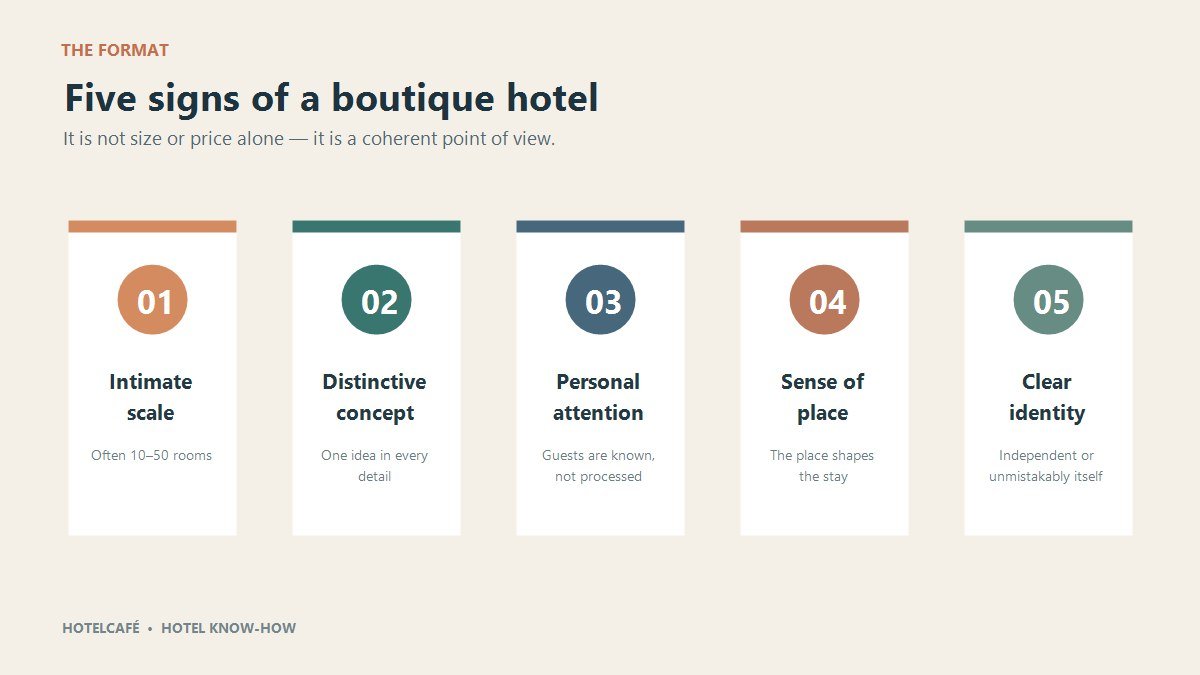
5 signs of a boutique hotel
1. Small size. Most often the range given is 10 to 100 rooms, and a typical boutique hotel has 10–50. In a big hotel it is hard to keep personal service. But this is a guideline, not a law: the best-known “boutiques” of the 1980s were noticeably larger.
2. Its own idea. The main sign. The idea can be retold in two sentences: a hotel in a former print shop, a collector’s house, a hotel built around local cuisine. Design here is a way to tell the idea, not decoration.
3. Personal attention. In a small hotel you can remember every guest: what they ate for breakfast yesterday, that they travel with a dog, which places they will like. Service is built around a person, not around an instruction.
4. A link to the place. A real boutique hotel could not stand just anywhere: its food, materials, craftspeople and stories are tied to the place. A test: if the hotel’s photos could be captioned with the name of any country, it is a beautiful hotel but not a boutique.
5. Most often, independence. A classic boutique hotel belongs to one owner or a small team. But many chains now launch “boutique” brands, and some consider them real while others call it marketing. There is no single opinion.
Stars, luxury, a spa, a restaurant and a high price are not part of the definition. A boutique hotel can be expensive or modest.
How a boutique hotel differs from other formats
| Format | What matters in it | How it differs from a boutique hotel |
|---|---|---|
| Chain hotel | The same standard everywhere | Predictable, while a boutique hotel is unique. Usually noticeably bigger |
| Luxury hotel | Luxury and formal service | A boutique hotel can be luxurious but does not have to be. A luxury hotel is not always a boutique |
| Lifestyle hotel | Atmosphere, shared spaces, a certain audience | Lifestyle describes the guest, boutique describes the hotel itself. Lifestyle hotels often belong to chains |
| Design hotel | Design | A boutique adds service and a link to the place (in our opinion) |
| Mini hotel, family hotel | Small size | The size is there, but the idea may not be |
| Guesthouse, B&B | Home atmosphere, hosts nearby | A boutique hotel is conceived as a hotel, with staff and full service |
Three simple cases:
- The hotel is small, but the rooms are like anywhere else and the service is “like everywhere”. This is a mini hotel. A good format, but not a boutique.
- The hotel is beautiful, but has no idea and no person who will meet you and remember you. This is a stylish hotel, not a boutique.
- The hotel belongs to a chain, but each property is designed for its place. This is a lifestyle hotel or a hotel from a chain’s collection. Whether to call such hotels boutiques is up to each person.
Common misconceptions
“Beautiful means boutique.” Beauty is a consequence here, not the definition. Without an idea and attention to the guest it is just a stylish hotel.
“Small means boutique.” Size is more of an entry ticket. A small hotel without character remains just a small hotel.
“Boutique means expensive and five stars.” No, the price depends on the place, the season and demand, not on the name of the format.
“It says ’boutique’, so there is a certificate.” No. Stars are awarded to hotels, but the title “boutique” is not: any owner can declare a hotel a boutique.
“It is enough to buy designer furniture.” The idea must be visible everywhere: in the breakfast, in the name, in how the receptionist answers, in what you offer the guest outside the room.
“A boutique hotel is about renovation.” It is about management. An expensive renovation with indifferent staff does not create a boutique.
How to check that it is a real boutique hotel
- Can the hotel’s idea be described in two sentences?
- Do the photos make it clear that this is exactly this place and not any country?
- Up to 100 rooms, and preferably up to 50?
- Do they remember the guest here and adapt the service to them?
- Is there a link to the place: food, people, materials, stories?
- Is the hotel independent, and if it is part of a chain, has it kept its own face?
If most answers are “yes”, it is most likely a boutique hotel. If not, it may be a good ordinary hotel, and there is nothing wrong with that.
Boutique hotels in Georgia
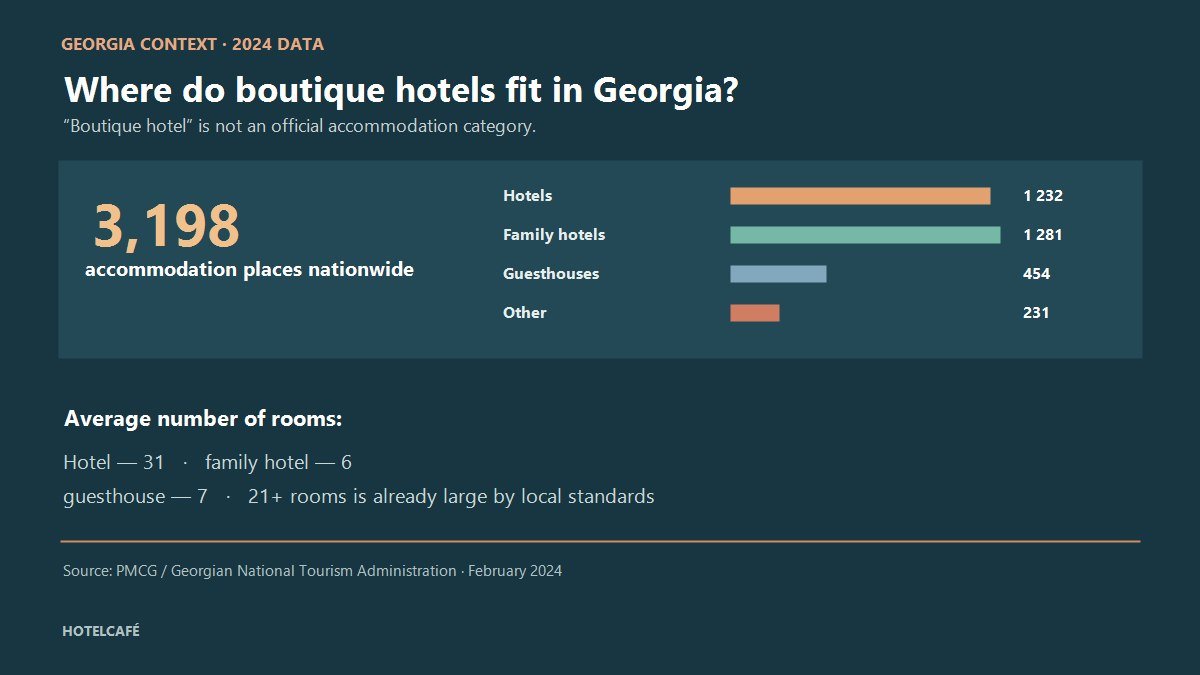
There is no official category. The Georgian National Tourism Administration divides accommodation places into types: as of February 2024, Georgia has 3,198 accommodation places, including 1,232 hotels, 1,281 family hotels, 454 guesthouses and 231 other facilities. The word “boutique” is not among the types, and we found no official criteria in open sources. So any hotel can call itself that, and there is nothing to confirm it.
What counts as a large hotel. Hotels of large capacity are those with 21 rooms or more. By our calculation, a hotel has about 31 rooms on average, a family hotel about 6 and a guesthouse about 7. So by Georgian standards even a small international boutique hotel of 50 rooms is already a large property.
What this means in practice. For a guest, the word “boutique” in Georgia guarantees nothing, so look at the signs, not at the signboard. For an owner, an empty word does harm: the guest expects an idea and attention, gets an ordinary room and is disappointed. In our opinion, it is more honest to write “small stylish hotel” than to promise what is not there.
Difficulties of an independent boutique hotel
- Occupancy. In a hotel with identical rooms, bookings fit together easily, like pieces of a construction set, and almost no gaps are left in the booking chart. In a boutique almost every room is special and has its own category, and it is much harder to arrange bookings so that no empty nights remain between them.
- Quality staff. You need not just people but those who can give guests extra attention and hold that level every day. There are few such people, and without them it is very hard to keep the format: the main promise of a boutique rests exactly on them.
- Moving into chains. Some independent boutique hotels join chain collections or are sold, sometimes losing their uniqueness.
In short
A boutique hotel is neither a “beautiful” hotel nor a “small” hotel. It is a hotel with an idea, where a person remembers the guest and the place is felt in every detail. The word has no official meaning, and Georgia has no official category either, so look at the substance, not at the word.
Sources
- Georgian National Tourism Administration data via the review PMCG, “Hospitality Sector in Georgia”: number of accommodation places and rooms by type, the 21-room threshold.