

Weight-loss drugs like Ozempic and Wegovy have stopped being a medical story and become a factor in the restaurant market. Chains are rewriting menus, analysts are counting the losses, and Gordon Ramsay calls the whole thing stupid. Here are the numbers, plus a separate look at what to do with them in a country where food arrives in a mountain.
How many people take weight-loss drugs
According to Gallup, the share of American adults taking these drugs rose to 11–12% in 2026, up from 3% in 2024. PwC’s analysis of Numerator data shows that by May 2026 roughly one in five American households included a current user, against 9% in January 2025, and 54% of users had been on the drugs for more than a year.
This is not only an American story. A PwC survey in Saudi Arabia, the UAE, Qatar and Egypt found that 9% of consumers take prescription weight-loss drugs, nearly double the global level, while another 43% are open to starting. Worldpanel data puts a user in about 9% of Saudi households, 6.3% in Great Britain and 2.4% in Brazil. A J.P. Morgan estimate cited by CNBC suggests more than 30 million Americans could be on such a treatment by 2030, up from 10 million in 2026.
What it does to revenue
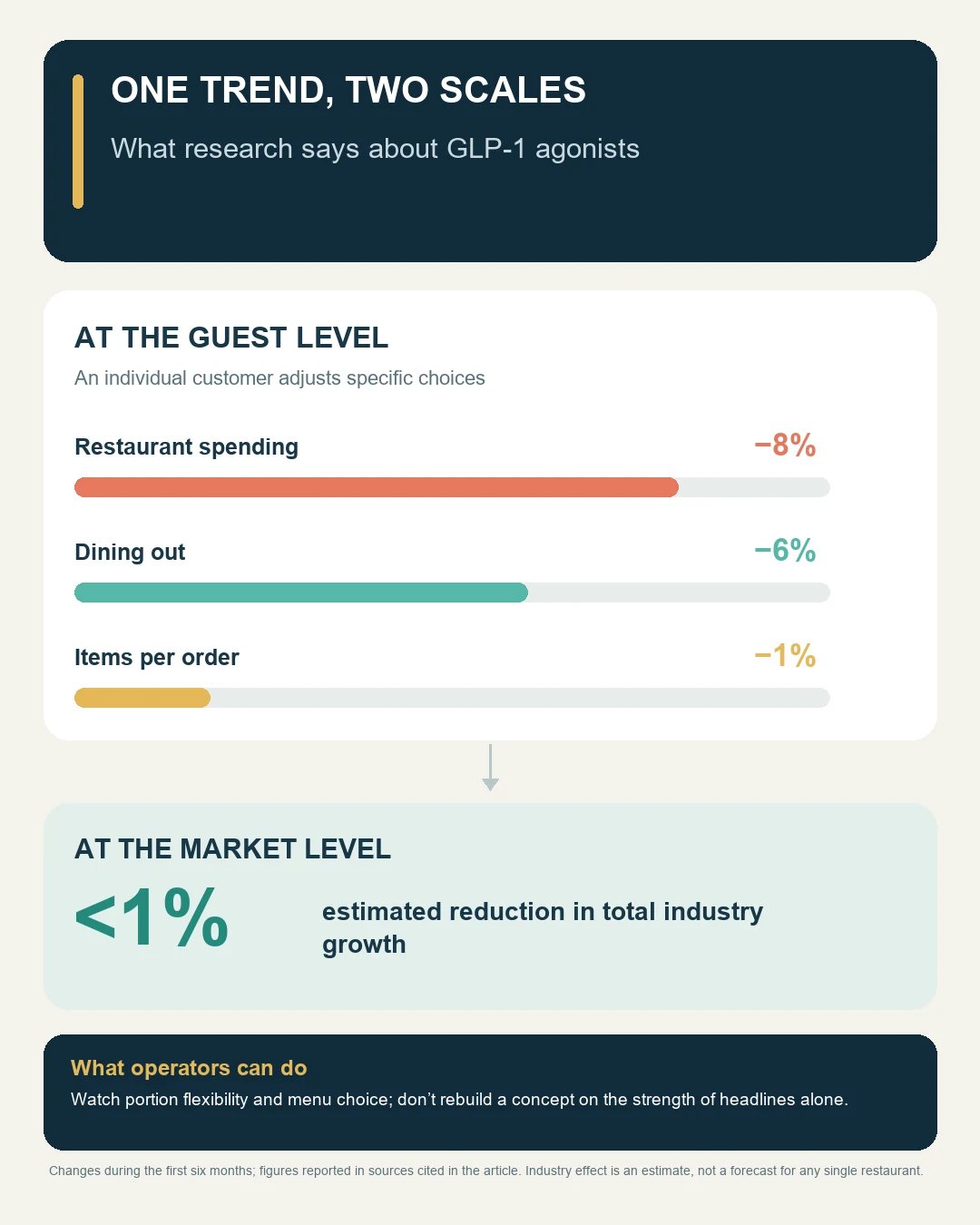
A Cornell University study published in the Journal of Marketing Research tracked spending across 150,000 households: in the first six months of treatment, grocery spending falls by an average of 5.3%, and by more than 8% in high-income families. Restaurant spending over those same first six months drops by an average of 8%.
The overall effect on the industry, though, is milder than it sounds. Bank of America data shows that among people taking the drugs regularly, restaurant dinners fell 6%, while total restaurant revenue during dinner hours slipped by about 0.4%. Analysts at William Blair calculated that even a doubling of the user base over five years would cost the industry less than 1% of sales growth and around 5% of traffic, with the flexibility of restaurants acting as a buffer.
What changes is the shape of the order rather than its size. Circana found in January that these guests cut the average number of items per order by only 1%, while choosing main dishes over sides, with demand for vegetables and fruit rising. In an Acosta survey, 34% said they eat out less often, but 48% of Gen Z and millennials said they eat out more, simply ordering differently: 42% of younger guests more often split a dish between two people.
How the chains are responding
For guests on weight-loss drugs, Smoothie King built a separate menu section: smoothies with 19 to 45 grams of protein, no added sugar, and 190 to 450 calories. Shake Shack released its Good Fit menu with lettuce-wrapped burgers, Chipotle sells a cup of chicken with 32 grams of protein, Subway offers protein pockets with more than 20 grams of protein for 3.99 dollars, and Burger King is testing downsized Whopper Bites.
The most telling shift is not about protein but about size. In January, Olive Garden rolled out a nationwide section of lighter portions built from seven dishes priced below the regular ones. The head of Darden explained that abundance means different things to different people, so guests get a choice rather than a rebuilt menu. P.F. Chang’s introduced medium portions. A small restaurant in Indiana added eight mini meals, which now account for about 20% of all orders. Where no such section exists, guests order from the children’s menu, which was designed for small appetites in the first place.
The counterargument
Gordon Ramsay called menus built around weight-loss drugs stupid: a restaurant, in his words, is about meeting people and having fun, and he finds tasting menus built around shrunken portions embarrassing. The data partly backs him up. The decline is modest, and people keep going to restaurants for the company, not for the calories.
Weight-loss drugs and Georgian restaurants: what to do
To be straight about it: there is no public data on how many people in Georgia take these drugs. So this will reach the visiting guest first, from the United States and from the Gulf states, where the rates are high.
Leave the supra alone. Abundance is the very product people travel here for. The right move is to add choice, not to cut the standard. Olive Garden did exactly that: seven extra dishes, not a new menu.
Georgian cuisine already has what the West is now inventing. Small dishes shared across the table are precisely the small plates the chains are introducing. Khinkali are sold by the piece, mtsvadi by the skewer. A guest with a small appetite only needs permission to assemble their own set: half portions, single pieces, half a grill platter. If you already serve half portions, you are in the trend — just say so on the menu.
Label, don’t rebuild. It is enough to mark five to seven dishes that are already on the menu: grilled chicken, trout, salads, matsoni, lobio. Add the protein in grams. A separate section for people on injections is not needed, since the chains themselves are moving away from medical labels.
Fried and fatty food is out of scope, and that is fine. The Cleveland Clinic advises such patients to limit fatty and sugary food and refined carbohydrates, while fried and greasy dishes worsen nausea and the feeling of fullness. Khachapuri and fried potatoes are not for this guest. They simply order something else.
Count the average check, not the portions. In a PwC survey, a third of heavy drinkers cut back on alcohol. For Georgia that matters more than the food, because the margin comes from wine. We looked at how wine can become a venue’s main product in our Marqués de Riscal case. That calls for a proper non-alcoholic list: lemonades, matsoni drinks, non-alcoholic wine. The American restaurant association also names a wider alcohol-free list as one of the answers to this trend.
A takeaway box is cheap courtesy. The guest will not finish the plate. Offer the container yourself, without waiting to be asked.
Who actually needs this. Hotel restaurants with foreign guests, health-focused and vegan spots in Tbilisi and Batumi, and places with corporate traffic. A village guesthouse does not.
How to test it cheaply. Industry consultants advise starting with the dishes most often left unfinished or split between two guests. Take two or three of them, offer half portions at a lower price, and watch the sales for a month.
What we do not know. Everything above transfers American and Middle Eastern numbers onto the Georgian situation. We have no statistics of our own, so you will have to test this against your own revenue.
Sources: CNBC: GLP-1 diets and restaurants; Restaurant Business: How GLP-1 drugs are, and aren’t, affecting restaurants.