
AI travel booking still works clumsily, but the largest travel platforms are already opening their apps inside ChatGPT, and in September Meta and Trip.com joined them. The first results are modest: booking through a chat is inconvenient, and people still buy on websites. Yet companies are not waiting for the technology to mature, because travellers have already moved to AI. Here is who is entering AI assistants and why, and what a hotel in Georgia should do right now.
Who has already launched AI travel booking
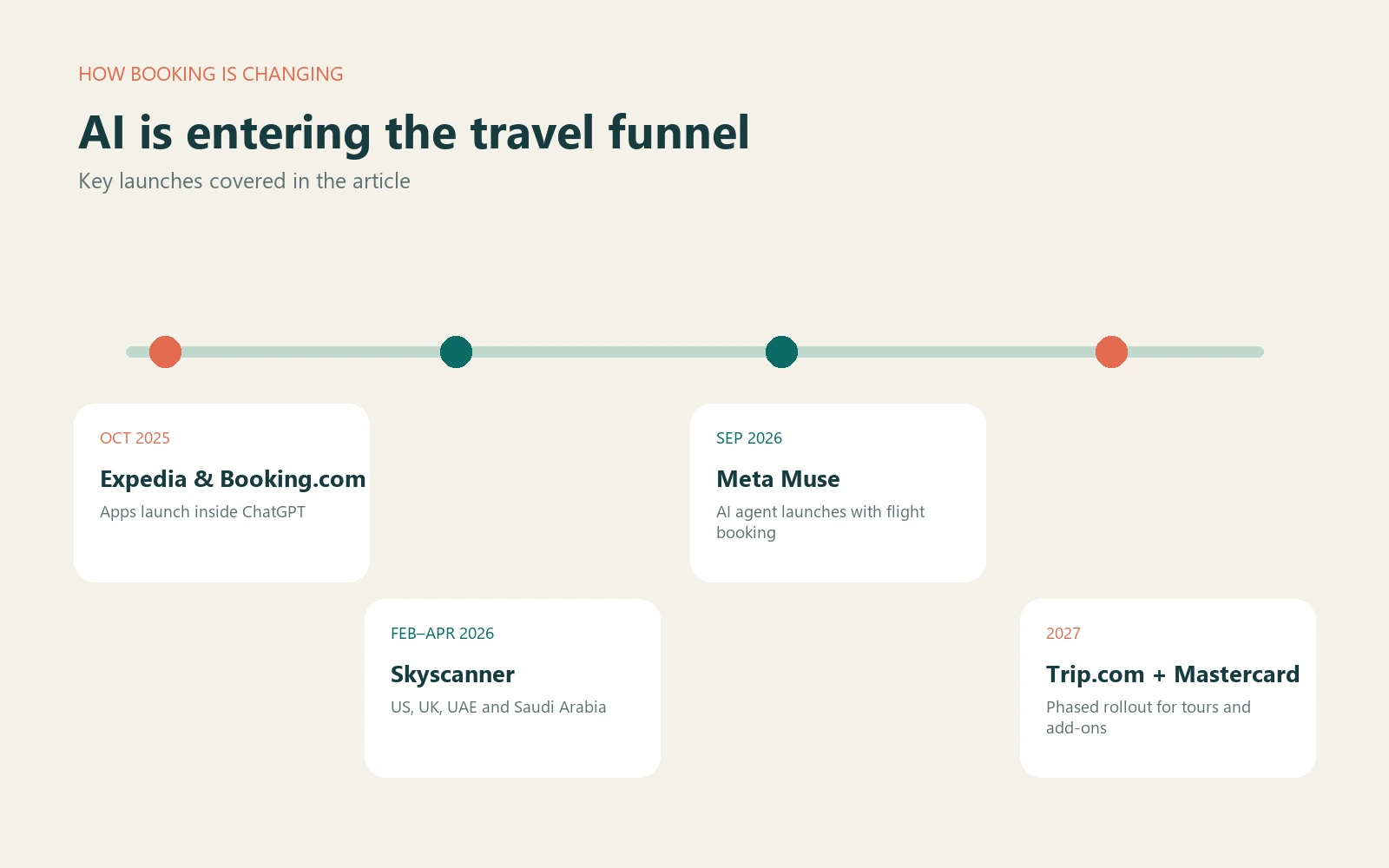
In October 2025, OpenAI opened ChatGPT to third-party apps, and its first travel partners were Expedia and Booking.com. That gave them access to an audience of 800 million users. Tripadvisor, Accor, Hyatt and India’s MakeMyTrip followed, and later IHG and Wyndham. Marriott introduced its own conversational search, Ask Bonvoy.
In February 2026, Skyscanner released a flight search app in the United States and the United Kingdom, and in April it added the UAE and Saudi Arabia, with prompts in English and Arabic. The company explained the choice by saying travellers from that region were among the first to plan trips with AI.
In September 2026, Meta launched its AI agent Muse with a booking feature: for now it covers flights, with stays promised later. Trip.com struck a deal with Mastercard: its assistant TripGenie will learn to book tours and add-on services, with a phased rollout in 2027.
How it works in practice
In March 2026, a Substack writer ran the same hotel request through three apps. Expedia did best. With Booking, prices in the AI answer and in the interface did not always match, and Accor returned only a map with pins. On top of that, each app has to be found and connected first, otherwise ChatGPT answers in general terms with no live prices. According to a Jotform review, the Tripadvisor app does not search restaurants or activities, and Skyscanner handles only flights.
Our editorial team also tried the Booking and Skyscanner apps. The personalisation people come to a chat for is not there yet: it is the same search, moved into the ChatGPT window. For unusual requests the results were worse than on the regular website.
People search in the chat and buy on the website
In September 2025, OpenAI launched purchases right inside the chat, and in spring 2026 it wound them down: people happily choose products in ChatGPT but do not complete the purchase there. Payment moved into partner apps, including Expedia and Booking. According to Walmart, checkout inside ChatGPT converted three times worse than on the retailer’s own website. In September, Expedia chief executive Ariane Gorin admitted that a chat alone is often not enough for booking. At Booking, bookings from AI services still account for less than 1% of room nights. In other words, AI travel booking still loses to the regular website.
Why AI travel booking cannot be ignored
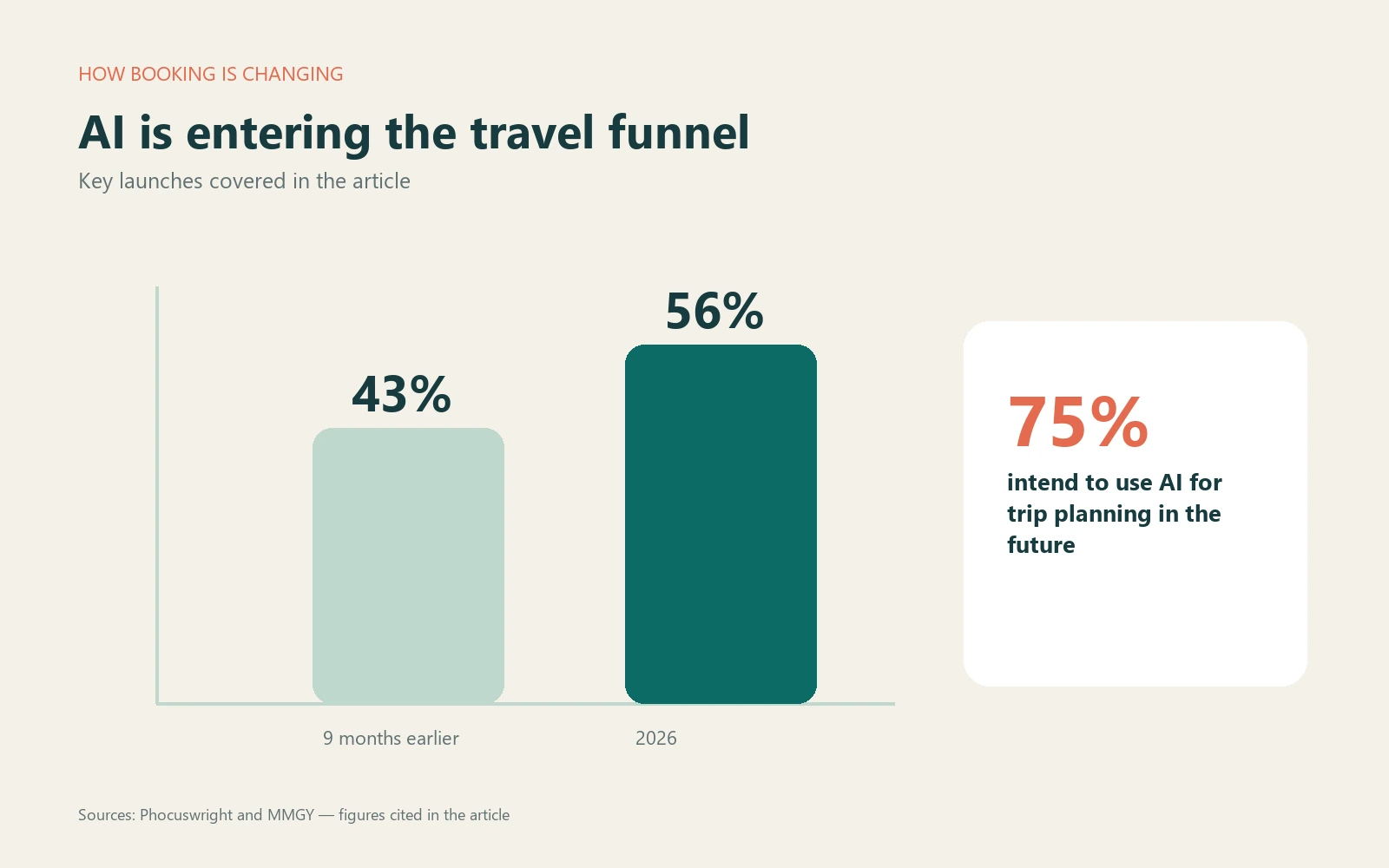
Because travellers are already there. According to Phocuswright, in 2026 56% of American leisure travellers used AI to plan at least one trip, up from 43% nine months earlier. The research calls it the fastest shift in traveller behaviour in more than a decade. An MMGY study shows a similar picture: more than half of travellers already use AI for planning, and 75% intend to do so in the future. By the authors’ estimate, the industry lags behind its customers by about two years.
People use AI in different ways. According to Simon-Kucher, 42% of travellers had built an itinerary with it, and 31% had searched for flights and hotels. There are dissatisfied users too: 52% of them complain about inaccurate answers. But these are growing pains, not a verdict. Expedia says AI traffic is still small but converts better than the rest, and the company calls optimisation for AI assistants’ answers its fastest-growing channel.
The main takeaway
Today’s clumsiness is temporary, and AI travel booking will only grow. Platforms are entering AI now, despite weak results, because they are betting on the next step: search, comparison and then booking will increasingly be handled by AI agents. We are confident this bet will pay off. Those who secure a place in AI answers will get the guests, while those who wait for the technology to mature risk being left on the sidelines. The old rule applies: first come, first served. This technology must not be underestimated.
AI travel booking: what a hotel in Georgia should do
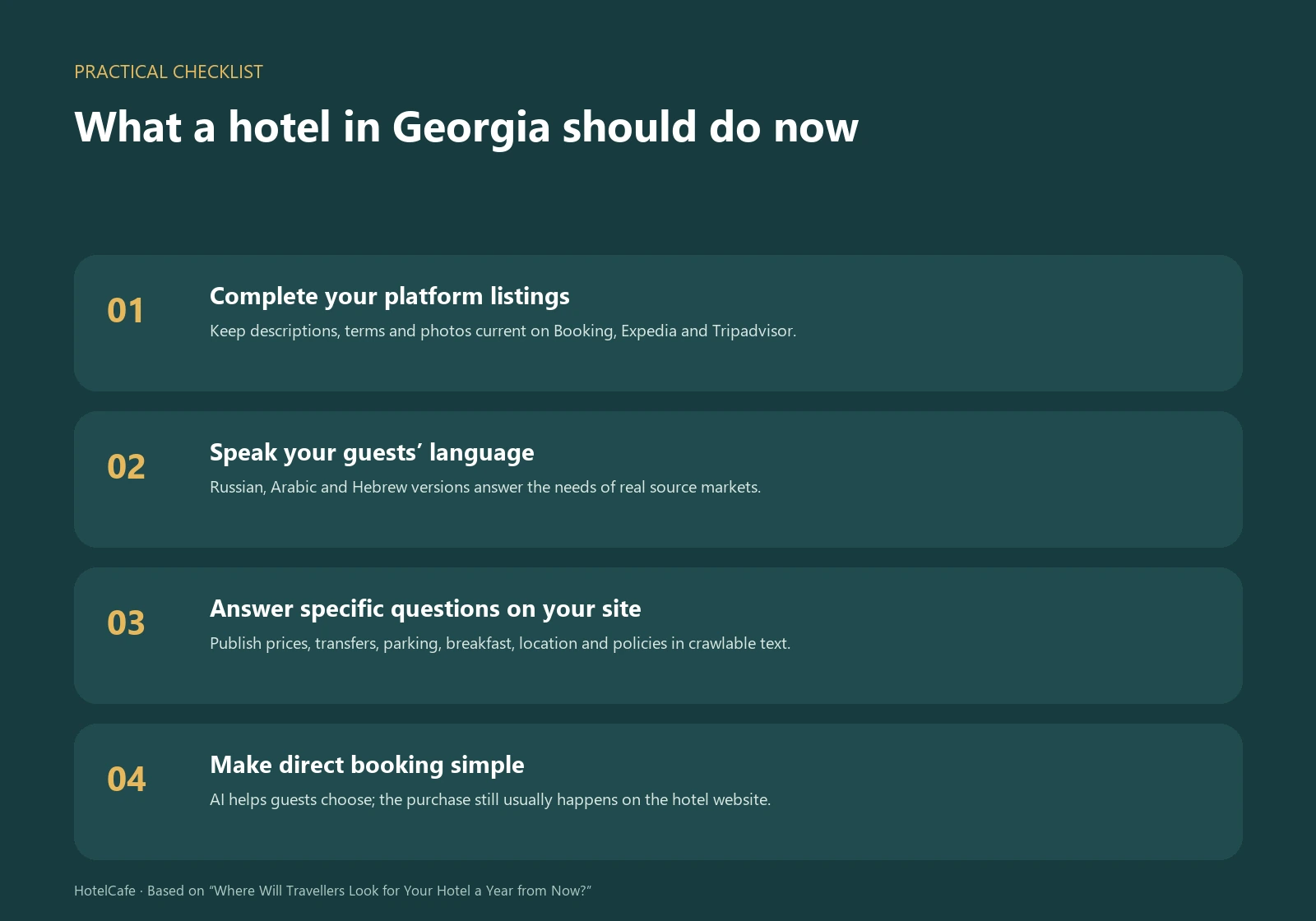
Your platform listing is your presence in AI. ChatGPT apps pull hotels from the Booking, Expedia and Tripadvisor catalogues. A full description, recent photos and honest terms there matter more right now than an AI project of your own. The platforms themselves spend billions on promotion, as our breakdown of Booking, Expedia and Airbnb marketing spend shows.
Speak to guests in their language. A traveller asks an assistant in their native language and looks for an answer they understand. According to the National Tourism Administration, the largest number of visits to Georgia in 2025 came from Russia. Visits from Israel grew by 29% year on year, an increase of 91,000. The Persian Gulf countries accounted for 145,513 visits, and Skyscanner has already built an Arabic app for that region. If a hotel’s website is only in Georgian and English, it speaks a foreign language to these guests. Russian, Arabic and Hebrew versions are among the most useful investments for the coming year.
Answer guests’ questions right on your website. AI assistants look for specifics: what it costs, how to get there, what is nearby, whether there is parking and breakfast. A page with such answers improves the chance that an assistant names your hotel.
Make direct booking simple. AI helps people find you, but for now the purchase still happens on a website. If booking with you is inconvenient, the guest will go where it is easy.
Tour operators and excursions should get ready before hotels. Trip.com will start AI booking precisely with tours and add-on services.
Start now, while competitors are few. Everything above is inexpensive and useful even without AI. When AI travel booking goes mainstream, the best places in assistants’ answers may already be taken. The industry lags behind travellers by about two years, and that is the window in which you can get ahead of competitors.