
Hotel staff motivation usually comes down to bonuses, but Brazilian entrepreneur Ricardo Semler rebuilt an entire hotel around it. He removed departments, trained every employee to do every job and gave the team 23% of revenue. According to him, consultants estimated the hotel would need 110 staff, but Botanique opened with 38 and turned a profit in its second year. We look at the small details behind this and at what a Georgian hotel can take from the story.
Who came up with it
Semler is not known as a hotelier. In 1980 he took over his father’s industrial company, Semco, and turned it into a famous experiment in management without hierarchy. His book Maverick became a worldwide bestseller. Like the Marqués de Riscal winery, whose Frank Gehry hotel works as an advert for its wine, Semler came to hospitality from another industry.
One of Semco’s rules was sharing profit. Profit was split like this: 40% went on taxes, 25% to shareholders, 12% to reinvestment, and the remaining 23% to employees. At other companies the share was 8–12%. Employees decided for themselves how to distribute the money. Semler wrote that profit sharing works under three conditions. It has to complement broad employee participation in the company’s affairs. Its rules have to be so simple that any employee can understand them. And everyone has to see the key figures every month: costs, overheads, sales, payroll, taxes and profit.
Botanique was an attempt to bring the same logic to hospitality. The hotel opened in November 2012 near Campos do Jordão, halfway between São Paulo and Rio de Janeiro, surrounded by about 283 hectares of forest. At opening it had six suites in the main building and 11 separate villas. São Paulo is about 200 km away, a two-hour drive. Besides the rooms there is a spa, a restaurant, a cinema, a library and stables. Semler and his wife Fernanda were joined as partners by AOL co-founder David Cole and The Body Shop co-founder Gordon Roddick.
A telling detail: during the 2008 crisis the project had 16 co-owners, and they struggled to agree. On Cole’s advice, he and the Semlers bought out most of the shareholders so that decisions could be made faster. The “fewer approvals” rule started with the owners themselves.
Where it began: guests dislike “fiefdoms”
Before building anything, Semler asked people what they disliked about hotels. The answer, he says, boiled down to one thing: hotels are designed for the convenience of management and staff and only pretend to care about the guest. A guest deals with a dozen separate services: reservations, reception, concierge, parking, room service, housekeeping, security, the cashier, the restaurant and the spa. Each of them is more concerned with its own rules than with helping.
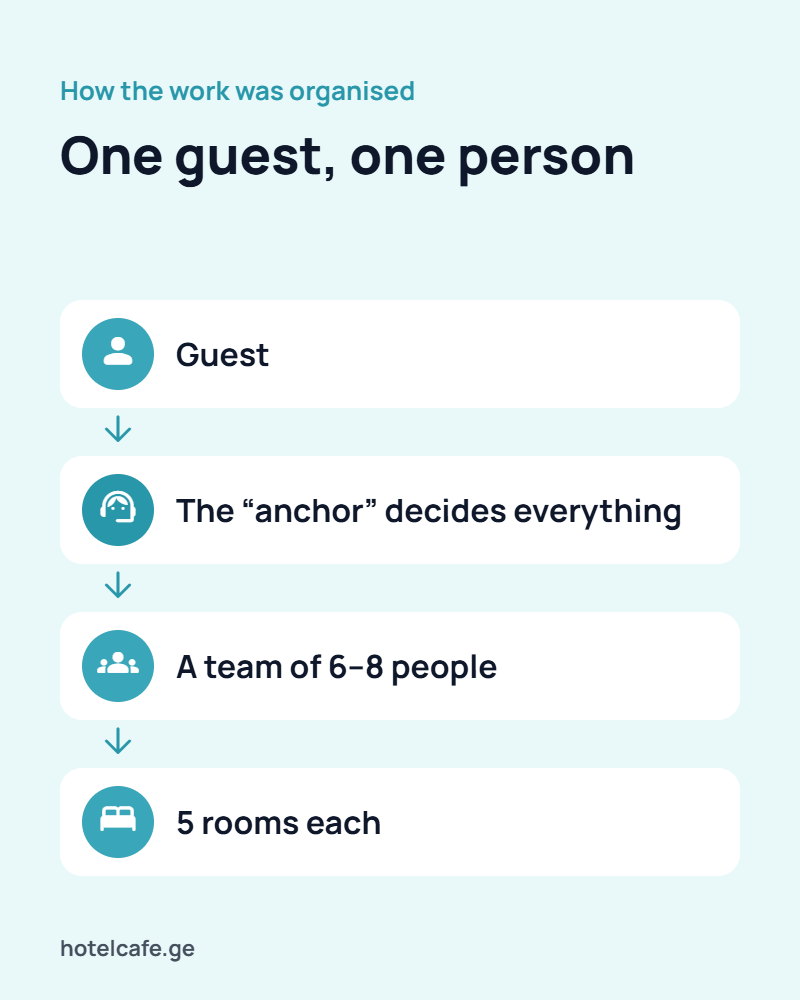
Hence the main principle: one person takes care of a guest’s entire stay, like a personal concierge or butler, but with full authority to make decisions. Semler has said that a structure built on departments stops a hotel from organising its work around the guest.
How the work was organised
The model rested on five decisions.
- One guest, one person. Each guest was assigned an “anchor”, an employee who arranged the whole stay. Guests could sort out any request through a single internal phone line or right at the bar.
- Small teams and “their own” rooms. A team of six to eight people looked after guests from start to finish. Everyone on it was trained as a concierge, housekeeper, waiter, cook, bartender and barista. Each staff member was responsible for a cluster of five rooms, so there were no departments between the guest and the staff.
- No formalities. There was no front desk, guests signed nothing and no one asked for a credit card. The bill arrived by email after departure, and it was disputed only a handful of times. Check-out time was dropped too. Usually a guest has to vacate the room by noon so it can be cleaned for the next arrival. At Botanique about 10% of the rooms were deliberately left unsold so that guests could leave when it suited them: if someone stayed on, a new guest could be put in a free room. By our calculations, with 17 rooms that means one or two rooms, so the hotel knowingly gave up some revenue so that no one hurried the guest.
- No tips. Tipping was banned. Instead there was a fixed service charge, shared equally among everyone. Semler explains that guests saw care that staff were well paid for, not someone angling for an envelope left in the room.
- A share of revenue. The team received a share that, according to Semler, amounted to 23% of revenue. When occupancy was high, staff earned twice the usual industry wage; when it was low, they received the industry base rate. That is what hotel staff motivation rested on: everyone stood to gain when guests were happy and came back.
Hiring was thought through separately. The hotel recruited local people and deliberately avoided anyone who had worked in hospitality, because they would have had to be retrained. Most staff were trained from scratch and took on everything from making beds to leading hikes with guests.
The small details that made it work
“Remove the departments” is an easy idea to retell. But the details show that the hotel was shaped around the model from the start.
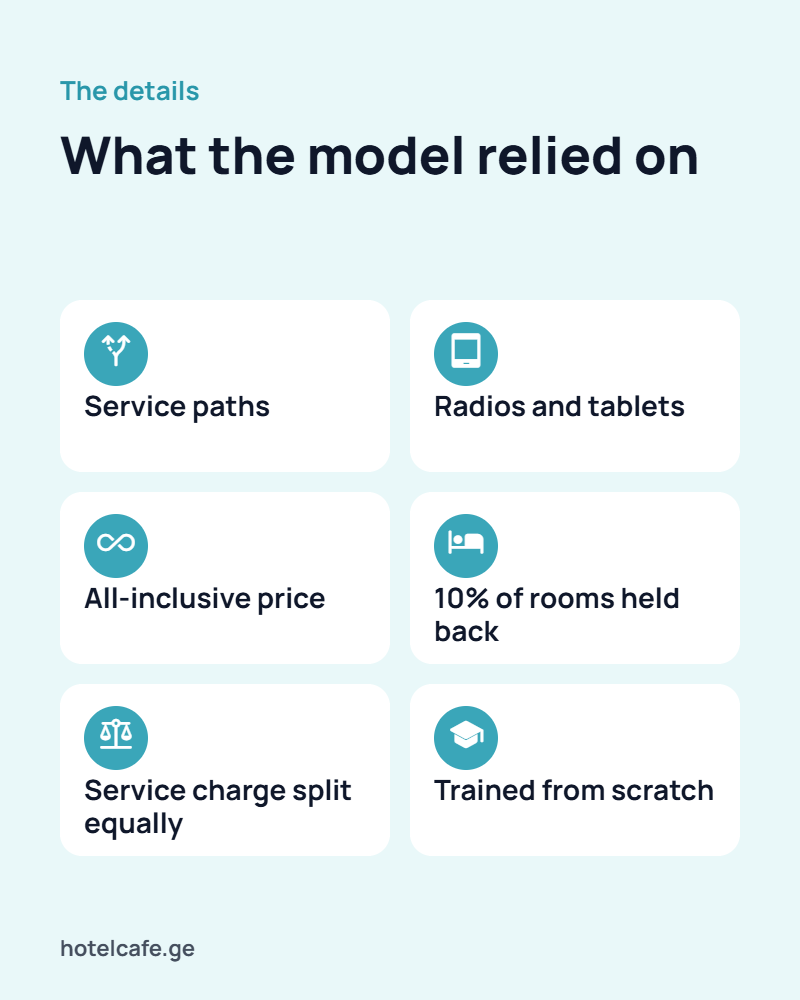
An all-inclusive price. In 2013 a room cost from 2,500 reais, about $1,224 a night. The price included food, drinks and service; only spa treatments were extra. With a price like that it was easier to do away with signatures and bills: almost everything was already included in the room rate.
A building made for the team. Service paths ran across the grounds, and guests only met staff when they wanted to. In the spa, the architects added a service lift so that used towels and robes could be taken away out of sight.
Radios and tablets. Every staff member had a radio and a Wi-Fi tablet, and the team could see where “its” guests were. When a couple left their room, everyone got an alert, and someone took the service path to tidy it up quickly. As a result, rooms were freshened up three or four times a day.
Equal shares. Botanique split the service charge equally. As the OMD Ventures blog retells Maverick, Semco’s employees did the same with their profit share: they decided to give everyone the same amount regardless of salary. When money is shared equally, there is no point in competing for “profitable” guests, and people are more willing to cover for each other.
Time to get it right. A Forbes journalist who visited the soft opening in December 2012 noted that the anchor system was still being fine-tuned. David Cole, owner of the Twin Farms resort in Vermont, had advised in advance to plan how to recruit, train, motivate and retain people. His recipe was trust, sharing and continuous learning.
The arithmetic: why 38 people on double pay cost less than 110
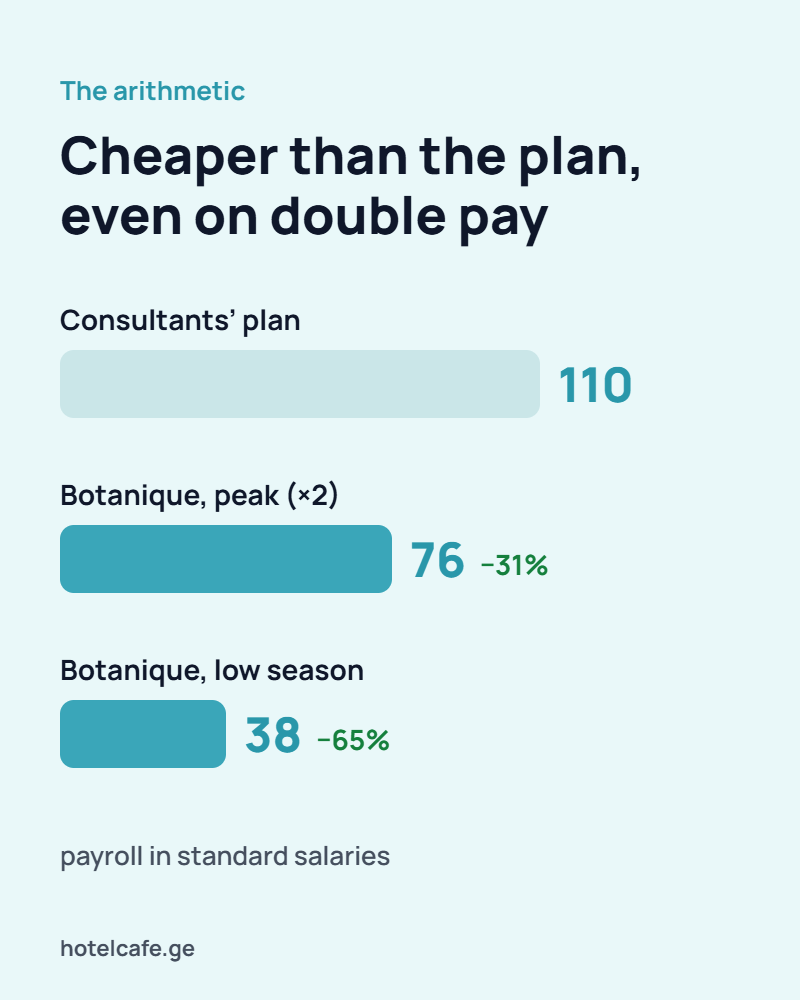
Semler writes that he asked two consulting firms to estimate the headcount: one came up with 110 people, the other with 105. The hotel opened with 38. Ten years later the number was the same, and most had been there since day one. Hotels usually expect to break even in their sixth year, while Botanique was profitable by the end of its second.
Why does this pay off if people are paid more? By our calculations, even if all 38 staff earn double, that is 76 standard salaries, 31% fewer than 110. In the low season, at the base rate, the payroll is almost a third of the consultants’ plan. Most importantly, staff costs fall on their own when there are few guests and rise when the hotel is earning.
This is exactly the flexibility hotels usually lack. According to the analytics firm HotStats, in 2025 labour costs at non-union US hotels were 33.5% of revenue, compared with 43% at unionised ones. The firm’s conclusion: the winners are operators who adjust staffing to demand.
The hotel did not become any simpler for it. According to Semler, it was called the best in the country on the strength of TripAdvisor reviews, awards and lists from Condé Nast and Travel + Leisure. He says the smaller headcount was possible precisely because of the structure without departments and hierarchy.
Hotel staff motivation: what to take from this story
Botanique did not work because departments were removed. The Semlers did not copy the industry’s standard model; they built their own and worked it out down to the smallest details to suit their conditions. Hence the service paths and radios with alerts. Hence the all-inclusive price, which makes it easier to do without bills and signatures, and the reserve of free rooms instead of a check-out time.
Copying this system wholesale makes no sense: every hotel has its own conditions. But its core carries over to any hotel, including in Georgia: fewer people, each able to do more and earning a percentage of the result. Multi-skilled staff and a share of revenue are exactly what can make many local hotels stronger.
How to set it up depends on the property. A country hotel with full board, where guests stay for several days, will arrive at one set of solutions. A city hotel, where guests spend one night and dine out, will arrive at another. Botanique is worth reading not as an instruction manual but as an example that the standard model can be rebuilt to suit you.