
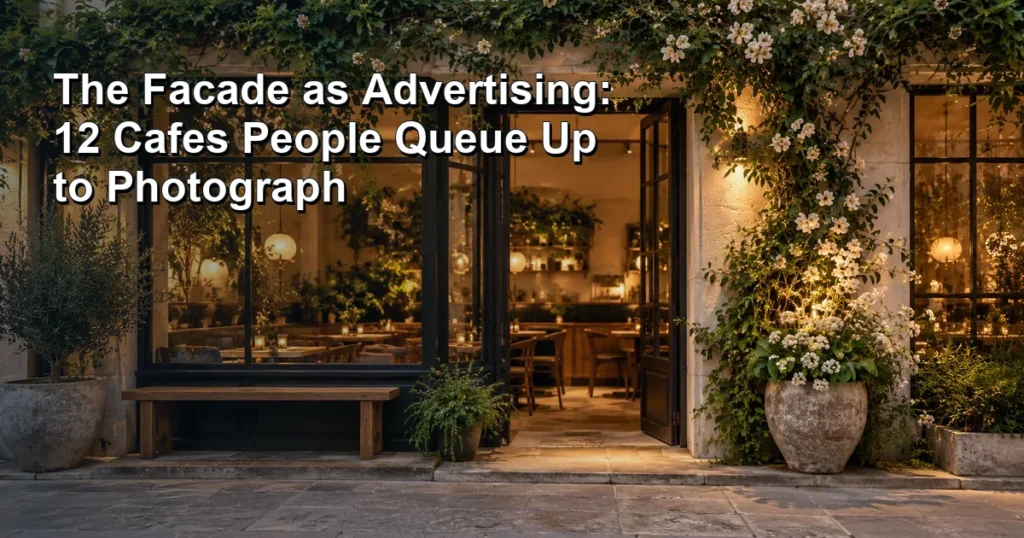
A cafe photo spot is not an interior design project and not a renovation. It is one object or facade that guests photograph and post themselves, without you paying for ads. We collected twelve stories from London, Paris, Kyoto, Sydney, Tulum and Seoul: what exactly the owners put up, usually outside, and what it did for the business.
This is a follow-up to our piece on thirteen tricks small cafes and bakeries used to get noticed. There the photo spot was one item out of thirteen. Here it is the whole article.
1. Peggy Porschen, London: a pink corner and flowers by season
The pastry shop opened in Belgravia in 2010 as a bespoke cake studio with a small cafe attached. Today it is called London’s original Instagram cafe: a pink facade, floral displays that change with the seasons, and almost always a queue of people waiting to be photographed at the entrance. The travel blog What’s Up Courtney writes that the queue for the facade here is separate from the queue for a table.
The first location did so well that a second parlour opened on the King’s Road in Chelsea in 2019.
What to take from it. When the decoration changes with the seasons, people get a reason to shoot the same place again and again.
2. Saint Aymes, London: wisteria on the facade
Sisters Lois and Michela Wilson opened their cafe in 2018 and covered the facade with wisteria. On their own site they say nobody had done flowers inside and outside at the same time before, and that this is what made them known without advertising. In their own post they call the facade the thing that made them famous.
Later the brand ran pop-ups in Japan and Abu Dhabi.
What to take from it. A floral arch above the door is the cheapest way into this story: it is visible from the street and takes no space inside.
3. EL&N, London: a cafe photo spot as a design brief
In an interview with Retail & Leisure International founder Alexandra Miller says it was essential for the cafe to be Instagrammable, and that she borrowed the flower wall idea from Kim Kardashian’s wedding. One site in Mayfair grew into 22 cafes in seven countries.
The next part is more interesting: in a 2024 interview Miller talks about a change of style, the same backdrops but in calmer tones. New York’s Pietro Nolita was all pink for nine years and then announced a new chapter it describes with the words elegance, refinement and maturity. Our reading: a photo spot ages, and it has to be refreshed.
What to take from it. Pink and floral no longer reads as a discovery. What works is not the colour but being the only one like that on your street.
4. The Churchill Arms, London: flowers as a line in the budget
The Kensington pub keeps around 100 pots, 48 window boxes and 42 hanging baskets on its facade and spends about 25,000 pounds a year on flowers, plus another five thousand on the Christmas display. Its own profile calls it the most photographed pub in London.
None of this happened by accident: the floral facade was built up over thirty-odd years by landlord Gerry O’Brien, and the pub has been recognised at the Chelsea show several times.
What to take from it. Flowers are not decoration, they are an advertising budget. For comparison, we looked at how many billions Booking, Expedia and Airbnb spend on marketing in a single quarter, while a facade works every day and costs nothing per passer-by.
5. Boot Cafe, Paris: they left the old sign alone
In the Marais a coffee shop took over a former cobbler’s workshop and kept its blue facade with the word Cordonnerie. Inside there are two tables; outside there is the door that makes people notice the place at all. AFAR writes that the cafe has a serious claim to being the tiniest and the most Instagrammable in Paris.
The facade turned out to be a stronger brand than the interior: a Boot Cafe with the same look now works in Seoul, and the Paris shop sells postcards of its own door.
The Seoul version is the same shopfront inside a Korean hanok.
What to take from it. An old sign or a door with a history is a ready-made photo spot. You do not have to invent it, you just have to not throw it away.
6. La Maison Rose, Paris: the pink house on the corner
The two-storey pink house with green shutters in Montmartre was known from Utrillo’s paintings, and in 2017 the restaurant was relaunched by the granddaughter of the previous owner. Today it is one of the most photographed corners in Paris, and in lists of Instagrammable Montmartre spots it usually comes first.
What to take from it. Sometimes the photo spot is simply the colour of a wall and a corner that frames well from the street.
7. Randy’s Donuts, Los Angeles: a doughnut on the roof
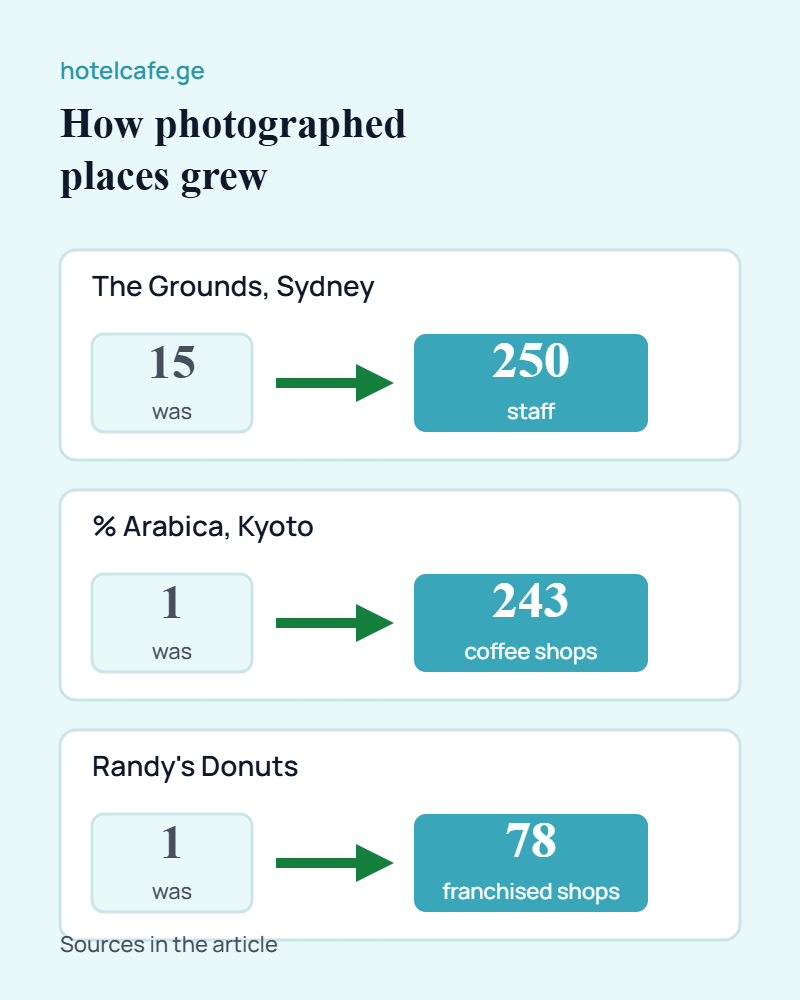
A giant doughnut about ten metres across has sat on the roof of this doughnut shop since the 1950s. The new owner bought the single location in 2015 and by 2021 had signed franchise agreements for 78 shops in California.
The key part of the story is that they replicate the photo spot on purpose. In La Habra, where the city would not allow a doughnut on the roof, the plan was to put it on the ground with a bench inside, so guests can sit in the hole and take a picture.
What to take from it. A large object visible from the road works as a sign and as a photo spot at once. Our piece on the Marques de Riscal hotel follows the same logic, only at the scale of a building.
8. Matcha Mama, Tulum: swings and a surfboard
This tiny smoothie shack opened in 2017. Instead of chairs there are swings, and by the entrance a painted surfboard reading “I love Tulum so matcha”. In their own post the cafe openly invites people to come and take the perfect shot.
They now have several locations in Tulum and one in Dallas, inside a gym. The downside is known too: the blog She Wanders Abroad writes that some people occupy the swings for ten minutes for a photo shoot and leave without ordering anything.
What to take from it. Swings and a sign cost very little. But put the photo spot where a guest is already holding a purchase, not in place of seating.
9. The Grounds of Alexandria, Sydney: a laneway rebuilt every season
The cafe opened in 2012 on the site of a concrete car park. The main thing here is the installations in the laneway by the entrance, which are completely replaced several times a year. In 2023 and 2024 it was named the most Instagrammed restaurant in the world by the number of tagged posts.
The business turned a profit six months after opening, and the team grew from 15 people to around 250, including an in-house stylist.
What to take from it. A permanent photo spot stops working over time. A changing one is a reason to come back and shoot it again.
10. % Arabica, Kyoto: the view and the cup
The Arashiyama shop stands by the Togetsukyo bridge. Only a few people fit inside, and in the shop’s own photos there is a queue at the door. People shoot themselves holding the branded cup against the river and the mountain. The brand grew from one location to 243 coffee shops worldwide by the summer of 2025.
What to take from it. If you have a good view, the photo spot is a bench and a cup with a recognisable logo, turned towards that view.
11. Kape Barako, London: a coffee shop in a phone box
This family business has worked since 2016 inside an old red telephone box on Hampstead High Street. Here the photo spot is the business itself: the box gets photographed by tourists who never intended to buy coffee.
The story is useful for another reason: right after opening, the council closed the shop while the owners sorted out a street trading licence.
What to take from it. Anything that goes onto the pavement or changes the look of the facade needs permission first. That is cheaper than sorting it out afterwards.
12. London Bagel Museum, Seoul: photogenic taken to the limit
The bakery opened in 2021 near Anguk station. Its interior, styled like an old London shop, spread across social media, and on weekends hundreds of people queued.
The numbers: in 2024 revenue reached 79.6 billion won, up 121 percent, with operating profit of 24.3 billion won and a margin of 30.5 percent. In 2025 the company was sold to the JKL Partners fund for around 200 billion won.
Then came the other side of growth. After the death of an employee and accusations of overwork, the brand took a heavy reputational hit. Queues also mean pressure on the people behind the counter.
What to take from it. A photo spot brings the flow, but somebody has to serve it. Plan the shifts in advance.
Cafe photo spot: what works in Georgia
The flow is there. In 2025 Georgia recorded 7.8 million visits by international travellers, 5.5 million of them tourist visits, a record. In the third quarter of 2025 most visits went to Tbilisi and Adjara, roughly 1.3 million each, and almost 59 percent of trips were for leisure.
But the easy years are ending: in the first half of 2026 tourist visits were almost flat, the overall flow fell by 3.3 percent and tourism revenue by 2 percent. Our reading: more venues are now competing for the same guest.
The channel is there too: at the end of 2025 Instagram ads reached 48.6 percent of Georgia’s population. And a photo spot works not through ads but through posts by guests themselves.
A few thoughts on how to fit this to your own place rather than copy it:
- Our seasons are harsh. A Batumi street in July and in January are two different places, so changing the decoration is closer to a necessity than a luxury here.
- Wine and the table are our own visual language. Qvevri, clay dishes and a vine over the entrance read in a photo without a caption and do not look borrowed.
- A property outside the city can do what a city venue cannot: a view, a bench, swings, a deck over a slope. In town you usually work with the facade, the door and the window.
- A family business is a photo spot in itself: the oven in plain sight, hands shaping dough, an old sign left by the previous owners.
- The test is simple. If a person photographs your place, will the photo make it clear that it is yours? If not, the photo spot works for the city, not for you.
Sources
- Peggy Porschen on its first Belgravia location, 2010
- EL&N founder interview: 22 cafes in seven countries
- EL&N on changing its visual style, 2024
- Pietro Nolita on leaving the pink concept behind
- Churchill Arms: 25,000 pounds a year on flowers
- Time Out: 32 years of landlord Gerry O’Brien
- Franchise Times: 78 franchised Randy’s Donuts shops
- LAist: the doughnut with a bench in La Habra
- SBS: The Grounds turned a profit in six months, 15 to 250 staff
- Time Out: the world’s most Instagrammed restaurant
- % Arabica: 243 locations by summer 2025
- Time Out: the council closing Kape Barako over its licence
- Korea Herald: London Bagel Museum revenue and sale
- Asia Business Daily: the brand crisis after an employee’s death
- National Tourism Administration: 2025 results
- Visits by region, third quarter of 2025
- Data for the first half of 2026
- DataReportal: Instagram reach in Georgia