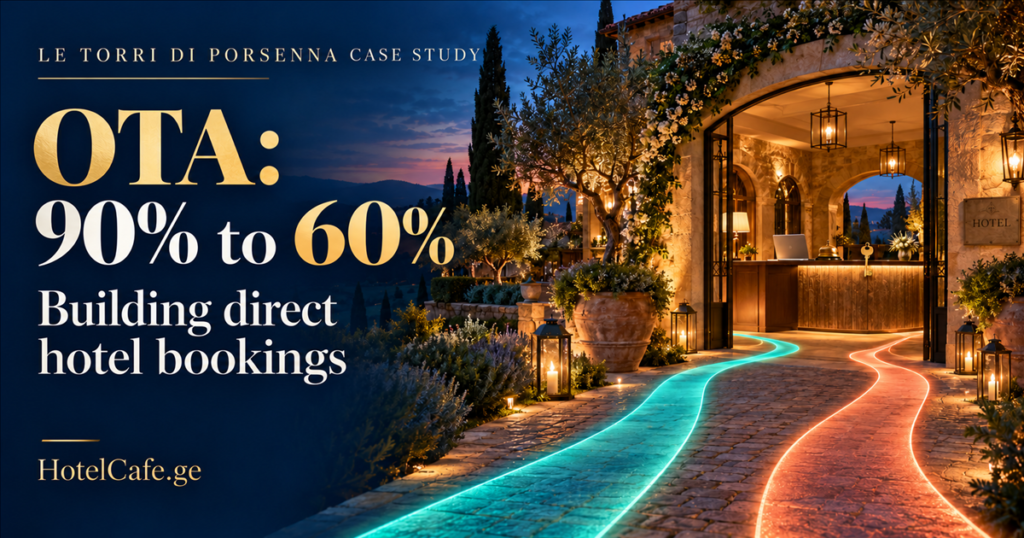
Direct hotel bookings at Le Torri di Porsenna grew after a coordinated overhaul of its sales channels. The spa property in Umbria, near the Tuscan border, rebuilt its website and booking engine, strengthened its direct offer, introduced paid advertising and attribution, and began monitoring prices across channels.
According to its agency, Booked Up Media, the share of bookings from online travel agencies fell from about 90% to 60% over roughly 90 days. In the first month, direct bookings increased by 31% and OTA commission costs fell by 20%.
The case shows how advertising, booking convenience and the guest offer work together. For hotel owners in Georgia, that connection is useful; one property’s results are not a promise that another will achieve the same percentages.

Where the property started
Le Torri di Porsenna is an independent accommodation property with a spa in Petrignano del Lago, Umbria. Before the project, about 90% of its bookings came through online travel agencies. It had never used paid digital advertising, and its own sales channel lagged behind intermediaries in several areas.
The agency identified problems including:
- an outdated website;
- a cumbersome booking engine;
- no consistent rate-parity monitoring;
- near-total reliance on OTAs and their commissions.
This matters. If a room looks like a better deal on Booking.com while the property’s own website is slow or requires too many steps, advertising will not resolve that problem. It simply sends more people into a booking journey they may abandon.
Five changes to increase direct hotel bookings
The project combined five related elements. Here is what the team changed and why those changes matter to a hotel owner.
1. Rebuilt the website
The property received a new, search-optimised website. Its purpose was to move visitors beyond attractive photographs towards checking available rooms.
A website built for direct hotel bookings needs to answer practical questions quickly: which rooms are available, what the price includes, how cancellation works and what makes booking here worthwhile. If guests have to hunt for those answers, the familiar OTA interface has an advantage.
A small hotel’s own website can be useful even when some visitors return to an OTA to complete their booking. An aggregator listing offers limited room to explain the details that distinguish a property: its precise location within a neighbourhood, mattress quality, breakfast, the view from a particular room or small services that matter to its guests. A website brings these arguments together, can strengthen trust and gives search and recommendation systems a source of information controlled by the property.
2. Simplified the booking process
The booking engine was redesigned with fewer steps and clearer pricing. This addressed the point where interest should become a purchase.
A visitor may already have chosen Le Torri, yet encountered friction in the old booking process. The updated website’s role is to persuade the guest; the booking engine’s role is to help them complete the purchase.
3. Gave guests a reason to book direct
Direct hotel bookings received a stronger offer. Booked Up Media does not disclose its details, but hotels commonly offer direct guests an extra benefit: complimentary breakfast, late checkout when available, or a discount on a transfer or another service. SiteMinder’s rate-parity guide describes similar approaches.
An extra benefit can make a direct booking more valuable while keeping the public room price the same across channels. Its terms should still be checked against the relevant platform agreement: matching the price alone does not guarantee compliance with every parity condition. Guests should immediately understand what they receive by booking with the property.
Choose the benefit around the hotel’s economics. One useful service with a manageable cost is better than copying another property’s promotion or promising a bundle of extras that guests rarely use.
4. Monitored rate parity continuously
The team monitored prices across OTAs and refreshed the hotel’s promotional calendar. The aim was to protect the direct channel from intermediaries displaying a cheaper price for the same room.
The base rate is only part of the comparison. Mobile discounts, OTA loyalty programmes, taxes, meals, cancellation conditions and the display currency can all change what the guest sees. The final amount and conditions matter. We examine how hotels set the underlying rate in our two dynamic-pricing case studies.
If an advertisement promises a good direct deal but an OTA in the next browser tab offers a better final price, the hotel may end up paying to attract a customer who buys through the intermediary.
5. Introduced Google Ads and booking attribution
The project included the hotel’s first paid advertising campaigns, targeting its brand name and searches with strong booking intent.
Brand advertising reaches people who already know the property and search for its name. OTA advertisements may appear alongside the official website at that moment. The property’s task is to retain demand that already exists for its brand.
To measure direct hotel bookings, the team also introduced attribution, linking each completed booking to its source. Without that link, it is difficult to distinguish campaigns that generate bookings from those that generate only clicks. Evaluating costs per completed stay also requires accounting for cancellations.
Hotel Captain Cook in Alaska offers another example of protecting branded demand. It used search advertising, display campaigns and metasearch. According to Sojern, metasearch generated 61% of the bookings it delivered to the hotel in 2022. The same source reports an approximately 60% reduction in OTA bookings over the partnership. The example illustrates the value of displaying the official hotel rate where travellers compare it with intermediary offers.
How the elements fit together
Our assessment: the project’s value lies in addressing several reasons guests leave the direct channel. The following explains the relationship between the changes, not their implementation order:
- The website helps guests find the official channel and understand the property.
- A clear booking engine reduces obstacles to completing a purchase.
- The direct offer gives guests a reason not to return to an OTA.
- Rate monitoring helps identify when an intermediary offers a better price or conditions.
- Advertising brings interested guests, while attribution shows where bookings originate.
Together, these elements can reduce familiar losses: paid traffic sent to an awkward website, a good offer that nobody sees, or a guest choosing an intermediary’s better price. The case does not isolate each change’s contribution to Le Torri’s results.
Results over roughly 90 days
Booked Up Media reports:
- a 31% increase in direct bookings in month one;
- a 20% reduction in OTA commission costs in month one;
- a fall in OTA dependence from about 90% to 60%, with the results panel specifying a 90-day period.
The case does not disclose the advertising budget, cost per direct booking or website conversion rate. A 30-percentage-point decline in OTA share therefore cannot automatically be counted as a profit increase.
The direct channel has costs too: website development, a booking engine, advertising, analytics and staff time. Compare the cost of selling through OTAs with the full cost of acquiring a direct booking.
Measuring direct hotel bookings in Georgia
These are our recommendations for assessing your own channel. Before making changes, record current performance and, where data is available, a comparable season from the previous year:
- booking and revenue share by channel;
- OTA commission payments;
- visits to the official website;
- the share of visitors who open the booking engine;
- bookings started versus bookings completed;
- average rate, cancellations and length of stay by channel;
- advertising spend and acquisition cost per completed direct stay.
For channel economics, focus on revenue remaining after selling costs. A simplified editorial calculation is:
Revenue after channel costs = revenue from completed stays − commissions − advertising − service fees − cost of direct-booking benefits − staff costs allocated to the channel.
This is not hotel profit: property operating costs and the cost of delivering the stay have not been deducted. Website development and other one-off costs also belong in the project’s payback assessment.
Compare the same stay periods and room categories. Otherwise, high season, a rate change or a more expensive room category can create the false impression that a channel has become more efficient.
What to check without a large budget
An independent hotel in Georgia does not necessarily need to start by replacing its entire website and launching a major campaign. It can first examine where guests are being lost.
Price. Compare the official website and main OTAs at the same time: total price, meals, cancellation, taxes and available categories.
Mobile booking. Follow the guest journey on a smartphone, from the homepage to payment. Note confusing screens, repeated data entry and unexpected conditions.
A reason to book direct. Define one concrete benefit and show it beside the price, rather than hiding it on another page.
Brand search. Check results for the hotel name across the main guest markets and languages. Who appears between the guest and the official website? One search on your own device cannot show the whole picture.
Attribution. Record both how a guest contacted the property—website, phone or message—and what brought them there: advertising, search or a recommendation. A phone call after an advertisement may be an advertising result rather than a separate source of demand.
If a site built to grow direct hotel bookings has booking problems, resolving them before expanding advertising is a sensible starting point. Then a limited test of brand search or metasearch can establish whether more spending is worthwhile. Judge it by completed stays, cancellations, acquisition cost and total property revenue.
What hotel owners can take from this case
Le Torri di Porsenna did not abandon OTAs: their share remained about 60% after the changes. Intermediaries were still a substantial part of sales. Our assessment is that maintaining several channels provides more resilience if one suffers a disruption or changes its terms.
The lesson is to evaluate advertising alongside price, trust and the convenience of your own website. Direct hotel bookings do not grow through one universal formula. The offer that persuades guests, and the cost of attracting them, need testing at each property.
For a small hotel, growing direct hotel bookings is ongoing work: comparing rates and conditions, improving the offer, tracking completed bookings and measuring selling costs. Direct hotel bookings also make it possible to build guest relationships and offer repeat stays without another intermediary.
Sources
- Booked Up Media: Le Torri di Porsenna case study — initial OTA share, changes made and reported results.
- Sojern: Hotel Captain Cook case study — marketing channels, metasearch’s share of bookings delivered by the provider and changes in OTA bookings.