

A hotel franchise lets you open a property under a well-known brand and plug into that brand’s sales system. But buying a franchise does not mean that Hilton, Holiday Inn, or any other chain built the hotel, owns it, or manages its staff.
Behind an international sign there is often a local owner. In one case, the owner runs the hotel independently; in another, they hire a separate operator; in a third, they keep their own name and use only the international chain’s reservation system, loyalty program, and other resources.
Below, we look at the models available, what the owner pays for, and how the different options already work in Georgia.
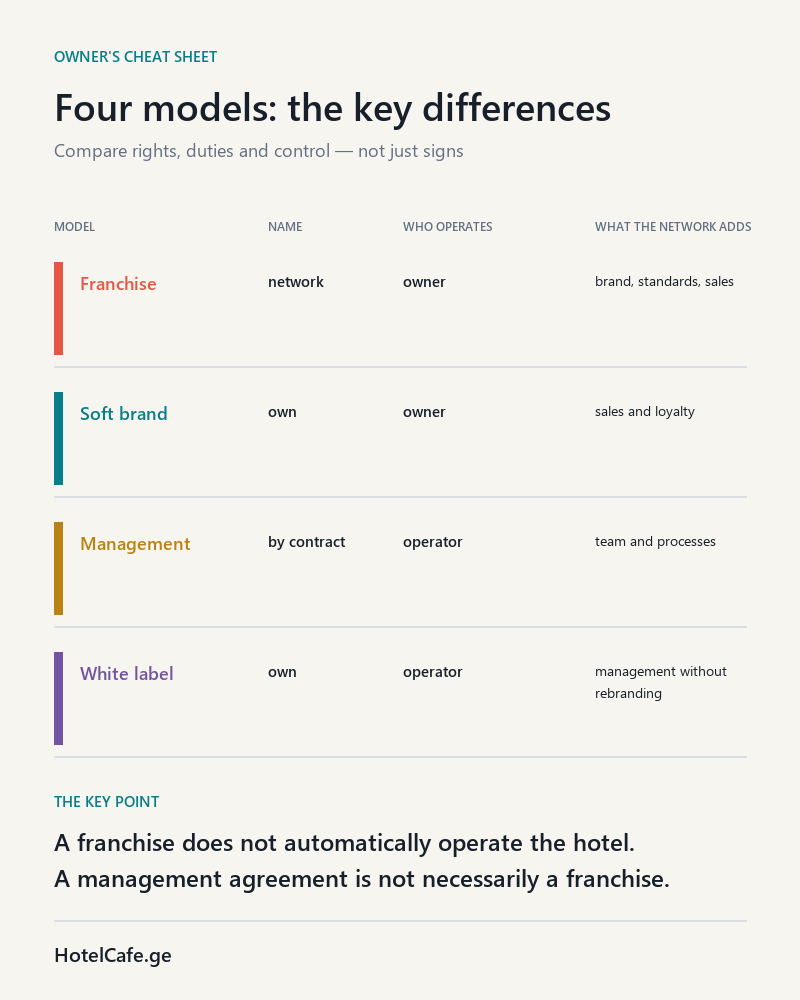
What Is a Hotel Franchise
Under a franchise agreement, the owner gains the right to operate under a hotel chain’s brand and use its business system. The exact package of services depends on the contract, but it typically includes:
- the brand name and visual identity;
- room and service standards;
- a central reservation system and a listing on the chain’s website;
- a loyalty program and marketing campaigns;
- corporate sales;
- technology and reporting;
- staff training;
- guidance on procurement and revenue management;
- regular quality assurance.
The investor, however, remains the owner of both the building and the hotel business. They finance construction or renovation, purchase equipment, hire staff, and carry the main operating risks.
The biggest misconception is that a hotel franchise is often seen as turnkey management. In practice, the chain may give the owner a brand and a working system, but it will not necessarily run the hotel on the owner’s behalf.
Why Owners Choose a Hotel Franchise
Building an independent hotel means developing everything yourself, from the concept and housekeeping standards to the website, sales, staff training, and corporate accounts.
A hotel franchise means you don’t have to start from a blank page. The owner gets a ready-made system and a brand that some travelers already trust. Access to the chain’s repeat guests can be a particularly significant advantage.
- enter the international market faster;
- secure more direct bookings;
- reduce dependence on Booking.com and other OTAs;
- implement operating standards;
- simplify team training;
- attract corporate clients;
- increase a bank’s or investor’s confidence in the project.
However, neither a hotel franchise nor the sign itself guarantees a profit. If the brand delivers few additional guests while mandatory fees and the costs of complying with standards are high, the independent model may prove more profitable.

The Classic Hotel Franchise: International Name, Local Management
Under a classic franchise, the hotel operates under the chain’s name. The guest sees Holiday Inn, Best Western, or another international brand, even though the property itself may belong to a Georgian company.
The chain provides standards, sales systems, and the right to use the brand. The owner either manages the hotel independently or brings in a third-party operator.
Advantages
- a recognizable name;
- ready-made standards;
- a central reservation system;
- a loyalty program;
- international marketing;
- training and quality assurance.
Limitations
- initial and ongoing fees;
- mandatory requirements for the building and its fit-out;
- costs of renovation and refreshing the room inventory;
- limited freedom in choosing design, suppliers, and processes;
- a long-term contract and possible early termination fees.
A franchisee cannot simply hang a famous sign on an existing building. The chain reviews the location, the concept, the owner’s financial capacity, and the property, and then determines the changes required.
Holiday Inn Tbilisi: An International Sign, a Georgian Business
Holiday Inn Tbilisi is one of the clearest Georgian examples of a classic hotel franchise. In 2010, Adjara Group opened the hotel in the renovated building of the former Adjara Hotel. The company describes it as the first Holiday Inn franchise in Georgia. It obtained the right to use the Holiday Inn brand while managing the property itself.
Holiday Inn Tbilisi is therefore not a hotel built and owned by an international chain. It is a Georgian hotel business operating under an international sign and according to its requirements. In this case, the owner and the operator are the same company; in other projects, the brand, the owner, and the operator may be three different parties.
Best Western Kutaisi: A Hotel Franchise Is Not Only for Large Hotels
According to Galt & Taggart, Best Western Kutaisi opened in 2017 as a 45-room hotel. The study classified Best Western’s Georgian projects as owner-managed franchises.
This is an important example for the regional market: the branded model is not limited to large hotels in Tbilisi and Batumi. The terms for joining the chain and the requirements for each new property are determined on a case-by-case basis.
Soft Brand: The Hotel Keeps Its Own Name
Not every owner wants to rename their hotel and turn it into a standard member of a large chain. For such properties, there are soft brands: collections of independent hotels within international groups.
The hotel keeps its name, concept, and much of its individuality, but gains access to the chain’s distribution, loyalty program, and commercial tools.
Advantages
- retaining your own brand;
- more freedom in design and guest experience;
- access to international sales;
- participation in a major chain’s loyalty program;
- the option to bring an already operating hotel into the collection.
Limitations
- selection by the collection;
- quality and safety requirements;
- ongoing fees;
- the need to integrate the chain’s systems;
- individuality is preserved, but full freedom is still not available.
Paragraph Resort: Its Own Name Within Marriott
Paragraph Resort & Spa Shekvetili operates under its own name while also being part of Autograph Collection, a Marriott collection brand.
The hotel keeps its own name and concept, receives the collection member designation, and gains access to Marriott’s infrastructure. The guest chooses Paragraph but can find and book it through the Marriott ecosystem.
This format is especially appealing to strong independent hotels with distinctive architecture, history, or concept that do not want to dissolve into a standard brand.
An International Collection Is Not Always a Hotel Franchise
On the surface, membership in a hotel collection may look like a soft-brand franchise: the hotel keeps its name, appears on an international website, and reaches a wider audience. However, the contract may primarily provide marketing, bookings, and status without giving the owner a full franchise system.
That is why the terms “franchise,” “soft brand,” and “collection membership” should not automatically be treated as synonyms.
Rooms and Stamba: Georgian Brands in an International Showcase
Rooms Hotels is an independent Georgian hotel brand. Rooms Kazbegi, Rooms Tbilisi, and Stamba are featured in the international Design Hotels collection, and Rooms Kazbegi is also available on the Marriott platform as a Design Hotels member.
The hotels’ names have not been replaced by an international brand. This example shows yet another path: first build a strong local product, then join an international collection while preserving your identity. Rooms Kazbegi is available through Marriott Bonvoy as a member of the Design Hotels partner program. The contract terms of individual properties are not disclosed in public sources, so it would be incorrect to automatically call this partnership a classic hotel franchise.
Management Contract: The Operator Runs the Hotel
Under a management contract, the owner finances the property and remains the owner of the business, but day-to-day operations are handled by a professional operator.
- budgeting and financial reporting;
- hiring managers and overseeing staff;
- sales and marketing;
- revenue management;
- procurement;
- service standards;
- delivering on the financial plan.
Unlike a standard hotel franchise, the owner pays not only for the brand and sales system but also for management. The operator’s compensation often consists of a base fee and an incentive fee tied to the hotel’s performance.

Swissôtel Batumi: A Hotel Franchise Plus a Separate Operator
The Swissôtel project in Batumi has an announced hybrid structure. Accor signed a franchise agreement with MC Construction, while KMHC LLP is to manage the hotel.
- local developer MC Construction is developing the project;
- Accor provides the Swissôtel brand and commercial system;
- a specialized operator handles management.
This structure shows that an owner can acquire a franchise for one brand and bring in a different professional company to run the property day to day.
White-Label Management: A Team Without Someone Else’s Sign
If an owner needs established processes and an experienced team but does not need an international name, they can sign a contract with a white-label operator.
The hotel continues to operate under its own name. The management company remains nearly invisible to guests, but it creates standards, builds the team, sets up sales, implements a PMS and reporting, manages pricing, and controls costs.
White label is sometimes called a “franchise without a sign,” but that definition is inaccurate. The owner is not buying the right to use a famous brand; they are acquiring management expertise.
Advantages
- the hotel keeps its own name;
- there is no need to build a management system from scratch;
- terms can be tailored to the specific property;
- some of the restrictions of an international hotel franchise do not apply.
Limitations
- the operator does not automatically bring a famous brand’s audience;
- results depend on the team’s competence;
- the owner needs clear KPIs and oversight;
- the website, reputation, and recognition of the hotel’s own brand still have to be developed.
Why a Hotel Franchise Is Not Right for Every Property
A well-known brand can boost sales, but it also brings an initial fee, royalties, a marketing fee, reservation fees, loyalty program and technology fees, training, and additional services. If management is contracted separately, the operator’s fee is added on top.
Then there are the costs of meeting standards: the chain may require you to change the layout, replace furniture, install specific safety systems, or refresh rooms regularly.
That is why comparing options by royalty rate alone is a mistake. A cheaper hotel franchise that requires an expensive renovation may demand more investment than a brand with a higher fee but requirements that suit the existing building.
What to Check Before Signing a Hotel Franchise Agreement
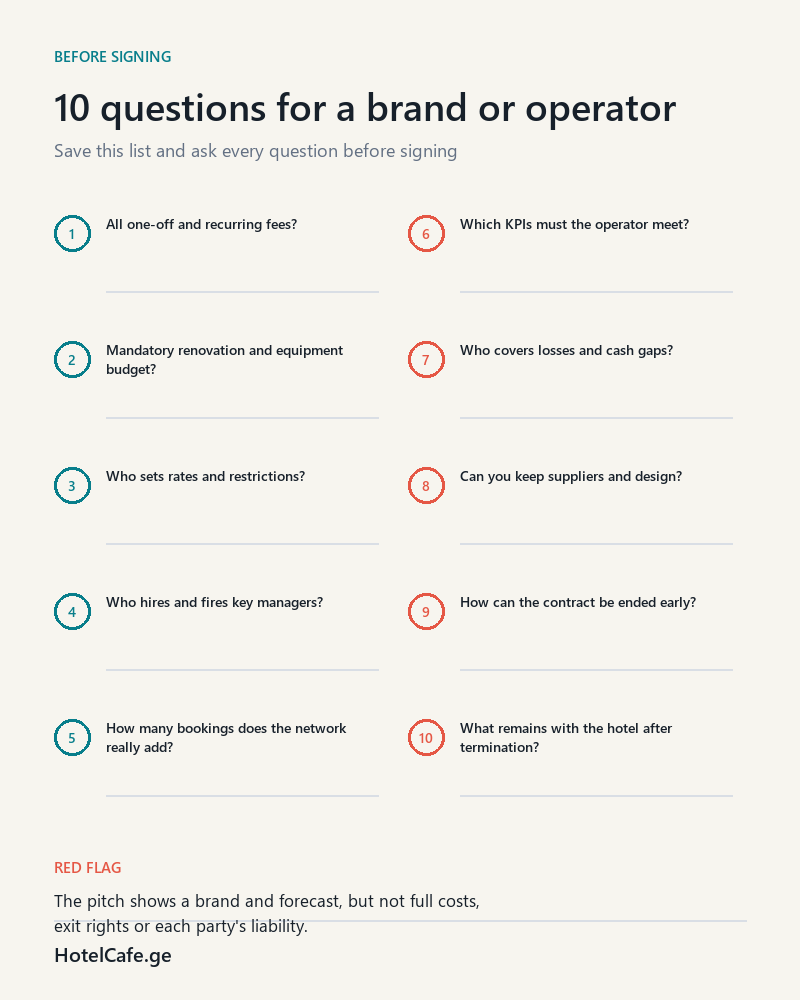
- How many additional bookings can the chain deliver in this specific city?
- What initial and ongoing fees will apply?
- How much will it cost to bring the property up to standard?
- Who will manage the hotel after opening?
- Which decisions will the owner be able to make independently?
- What is the contract term, and how much does early termination cost?
- Is the hotel required to use approved suppliers?
- Which metrics will make it possible to assess the value of the partnership in two to three years?
The right question is not “Is this brand well known?” but “Will its system generate more money than it costs the owner?”
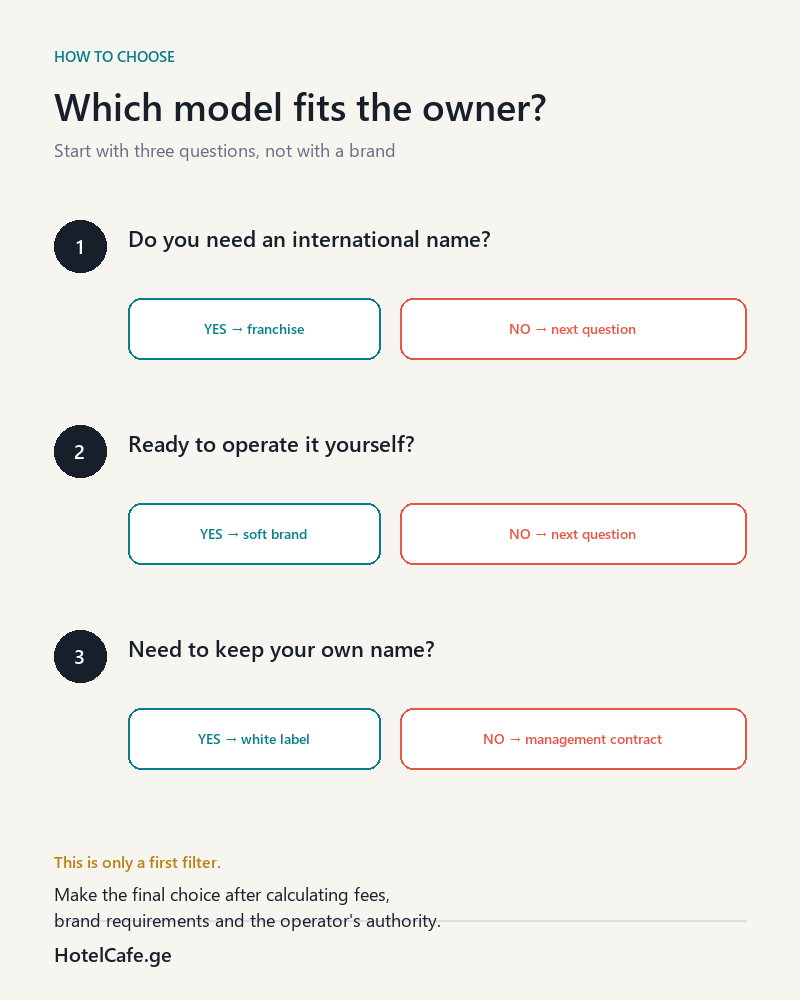
How to Choose the Right Model
A classic hotel franchise suits an owner who wants a famous sign and is prepared to run the property according to set standards.
A soft brand appeals to an independent hotel with a strong concept that wants to keep its own name and gain access to international sales.
A management contract can be useful for an investor without their own hotel team.
A white-label operator allows the owner to keep their own brand while entrusting professionals with designing and running operating processes.
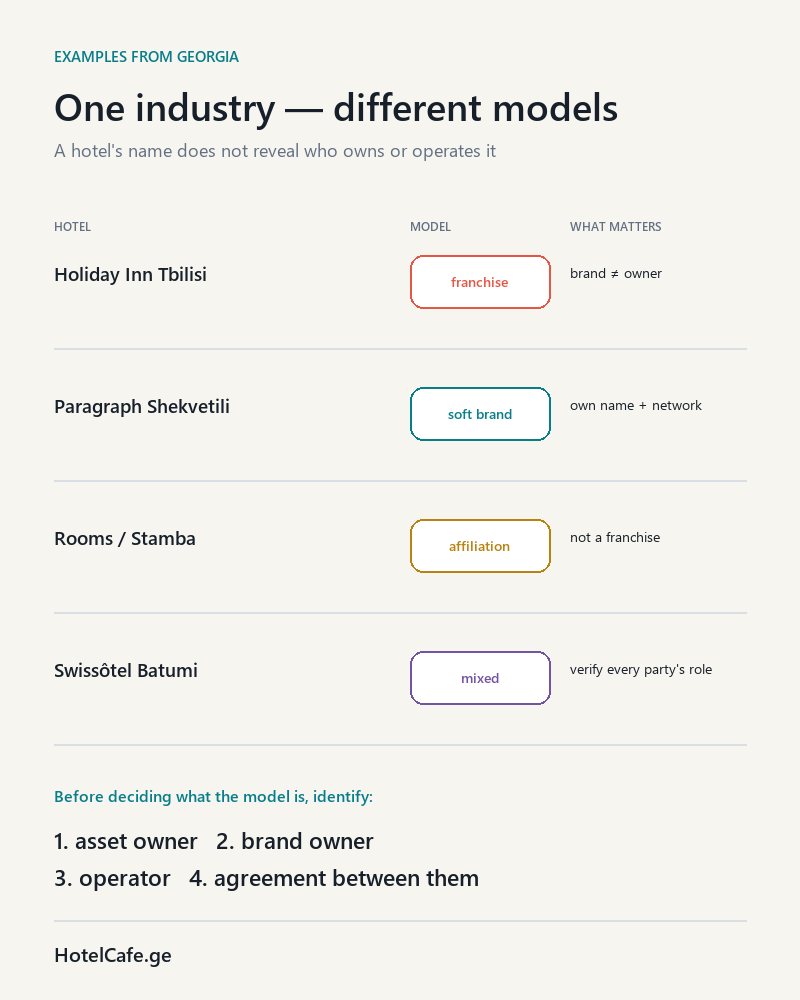
The Georgian market shows that these models already exist side by side. Holiday Inn Tbilisi operates under an international sign with local management, Paragraph keeps its own name within a Marriott collection, Rooms and Stamba use the international Design Hotels showcase, and Swissôtel Batumi has an announced structure with a separate owner, brand, and operator.
A hotel franchise is not a purchase of guaranteed profit. It is a purchase of specific tools, standards, and market access. The decision makes sense only when these capabilities can bring the hotel more than the cost of the contract, mandatory fees, and compliance with the chain’s requirements.