
A hotel PMS is the software where you manage bookings, check-ins, invoices and room cleaning. A notebook or a spreadsheet works while you have few rooms and sell through one platform, but once Booking.com, Airbnb, your website and messengers join in, things get messy: a room is sold twice, a price on one platform is outdated, nobody remembers what was promised to a guest. Below we explain what a PMS does, which types exist and what to look at when choosing one in Georgia.
What is a hotel PMS in simple words
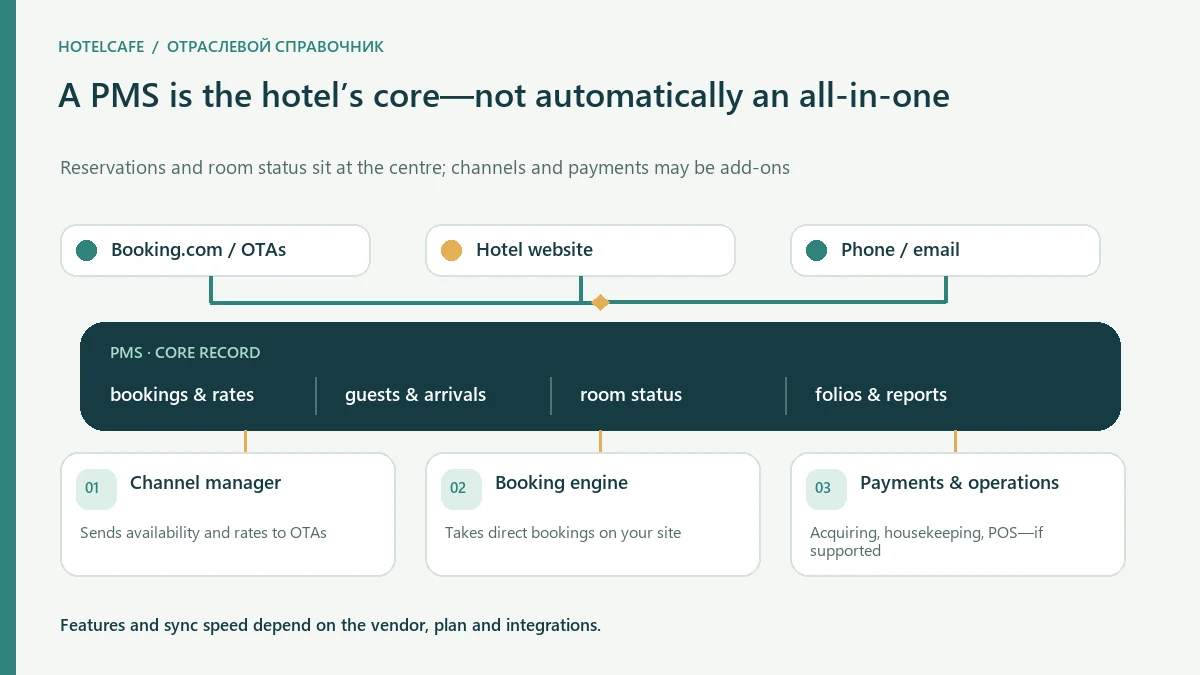
PMS (property management system) is the program where a hotel keeps everything about guests and rooms: who booked and for which dates, which room they stay in, how much they paid, whether the room is cleaned before the next guest arrives. Think of a big booking journal that updates itself: change something in one place and every employee instantly sees the current picture. Modern systems are mostly cloud-based: they open in a browser and in a phone app.
Why you need one
Does a hotel need a hotel PMS? Yes. The real question is which one, because different properties have different tasks. Here is what it covers:
- All sales channels in one place. Bookings from Booking.com, Airbnb, your website and phone calls land in one calendar.
- Protection from overbooking. This is when one room is sold twice. Together with a channel manager (more on it below), availability updates on all platforms right after each booking.
- Order in prices. Rates for seasons and days of the week are set in one place instead of on every platform separately.
- Check-ins and check-outs without confusion. The receptionist sees who arrives today, which room is ready and what the guest has already paid.
- Money and reports. Invoices, payments and reports on occupancy and revenue are calculated automatically, not by hand at the end of the month.
- Knowledge does not live in someone’s head. If an employee quits or the owner is away, the history of bookings and guests stays in the system.
What every PMS can do
Every hotel PMS has a basic set. What differs is convenience and depth.
- Bookings and rates. Check room availability, create, change or cancel a booking for an individual, a company or a group.
- Check-in and check-out. The receptionist’s work at the desk. In some systems a guest can check in alone, from a phone or a tablet.
- Invoices. Charges for the stay and extra services, issuing a receipt or an invoice.
- Guest profiles. Contacts, preferences, history of stays.
- Housekeeping. The status of every room: occupied, vacated, cleaned.
- Maintenance. Tracking breakdowns and repair requests.
- Reports. Occupancy, revenue, arrivals and departures, night audit (the summary of the day).
What can be connected to a PMS
Some features come with the hotel PMS, others are connected separately, sometimes for an extra fee.
- Channel manager. A program between your PMS and platforms like Booking.com and Airbnb. When a booking comes in, availability is updated everywhere at once.
- Booking engine on your website. A guest picks dates and books directly with you, without a platform and its commission.
- Online payment. Accepting a card at booking. More in the section about Georgia.
- Automatic prices. Revenue management systems raise or lower the price depending on demand.
- Restaurant and POS. If your hotel has a restaurant or a bar, a guest’s charges are collected into one bill.
- Housekeeping app. A housekeeper sees the list of rooms on a phone and marks what is cleaned.
- Electronic locks. A key card or a code opens the door from the system, with no keys handed out.
- Emails and reviews. Messages to guests before and after the stay, collecting ratings.
- Warehouse and accounting. For hotels with a kitchen and purchases.
Types of hotel PMS and which one fits you
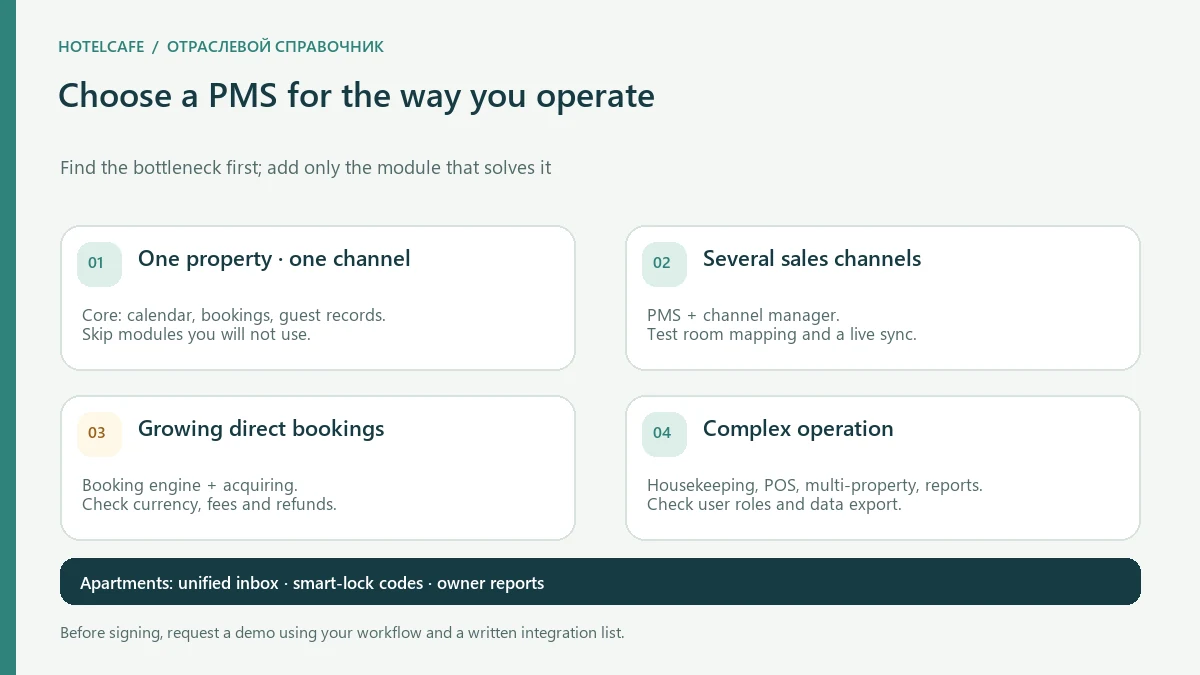
A simple system for a small property. If you are a small hotel or a guesthouse, sell mostly through Booking.com and need a calendar, bookings and guest records, the simplest system, possibly a free one, is enough. Expensive modules will simply be useless to you. Free plans exist, but they are limited: Sirvoy, for example, offers a free plan for one room that does not include a channel manager.
A system for a hotel that grows direct sales. If you already have a website and want more direct bookings, you need a booking engine, online payment and a channel manager. A simple system is not enough here. This is the stage where it pays to choose carefully.
A system for a complex hotel. A restaurant, conference rooms, a warehouse, several buildings or many sales channels: you need a full set of modules with kitchen and accounting.
Systems for chains. Large international brands usually run on solutions like Oracle OPERA. For a small hotel it is excessive in both features and price.
Apartments and short-term rentals are a separate class. Their logic is different: one shared inbox for messages from all channels, a single calendar, locks with codes and an owner’s account. If you rent out apartments, look for exactly that.
For scale: in 2025 Georgia had 2,783 hotels and hotel-type establishments with 54.3 thousand rooms. By our calculation, that is about 20 rooms per property on average. This is an average: it includes both tiny and very large properties. In our estimate, small properties are usually fine with systems from the first two groups.
What to look at when choosing in Georgia
Language. Check which languages the interface supports for staff and what the guest sees: emails, the booking page, the invoice. If your guests and staff speak Georgian, this matters.
Payment through Georgian banks. To accept a card on your website you need a bank’s payment gateway. In our experience, in Georgia these are mainly TBC and Bank of Georgia. Large system providers, as a rule, connect both banks to make it convenient for the client, while the others usually have at least one of the two.
So choose a system where the bank connection is already ready. In our estimate, if a system has no such connection, building it yourself is much harder and more expensive: you need programmers who write and test the integration, and it is worth doing only for very serious reasons.
When the connection is ready, you only get access at the bank and enter the details, with no code. A ready solution also already works for many hotels.
Ask the provider before buying which banks it works with. In our experience, paying by card through a Georgian bank is usually cheaper and more convenient for the guest than international services like PayPal.
Not every international system connects to Georgian banks. For example, Georgia is not on the list of countries where Cloudbeds’ built-in payments work. There you can accept a payment offline and record it in the system, and whether an external gateway works in Georgia, ask Cloudbeds.
Platforms. Make sure the channel manager connects to the platforms where you sell.
Accounting and reports. Built-in accounting is not needed by everyone: many keep their books separately. If it matters to you, ask what the system can do and how to export the data.
Housekeeping and staff. If you have several housekeepers, a cleaning app makes life much easier.
What the plan includes. In some systems the channel manager and the booking engine appear only on a more expensive plan. Ask what exactly is included in your price.
Trial period and support. Ask for a demo or a trial and check right away how fast support answers.
Which systems to look at
These are examples of hotel PMS, not a ranking. Features and prices change, so check them on the provider’s website.
| System | What we know |
|---|---|
| Exely | PMS, channel manager, booking engine and a website builder. The website lists TBC Bank and Bank of Georgia among payment partners. Payment links are sent by SMS. The booking engine supports 40 languages. The admin interface is available in Georgian, confirmed by the editorial team |
| FINA | A Georgian company. A hotel program: bookings, room occupancy chart, channel manager (Booking.com, Hotels.com, Expedia), housekeeping with an app for housekeepers, night audit, warehouse, accounting, restaurant and conference rooms. Suits a hotel with a restaurant and halls |
| OtelMS | According to its website, it has operated since 2013. Products: front desk, channel manager, booking engine, online acquiring, housekeeping module, reputation module, mobile version, website development. It offers solutions for hotels, small hotels, hostels, apartments and holiday homes. The website is available in Georgian, among other languages |
| Sirvoy | An international system for small properties. A free plan for one room and up to five extras: a website with a booking engine, guest emails, booking management. The official page lists these prices for one room with monthly billing: Starter €12 (invoicing, SMS, 24/7 support), Pro €44 (with a channel manager for Booking.com, Airbnb and others). The price grows with the number of rooms |
| Cloudbeds | An international all-in-one system for independent hotels, boutique hotels and hostels. Georgia is not on the list of countries where built-in payments work. A payment can be accepted offline and recorded in the system |
How much it costs
The price of a hotel PMS usually has three parts: a fee for the number of rooms or properties, a fee for modules (channel manager, booking engine, payments) and sometimes a commission on bookings made through the system. Free plans exist, but they are limited: Sirvoy, for example, offers one room and basic functions. Compare not the plan price but what is included for your hotel.
Where to start
Choosing a hotel PMS is easier in five steps.
- Write down where you sell: Booking.com, Airbnb, your website, phone calls, messengers.
- Note what you need right now and what you may need in a year: a website with booking, payment, a restaurant.
- Choose two or three systems and ask for a demo or a trial.
- Ask the providers about language, Georgian banks, what the plan includes and support.
- Start simple. If the hotel grows, you can change the system.
Frequently asked questions
Does a hotel PMS make sense if I sell only through Booking.com? If you have one small property and one channel, the simplest system, possibly a free one, is enough. When a website, payments and other platforms appear, you need a system with a channel manager and a booking engine.
Can I accept payments without a bank connection? You can take a payment on site or by transfer and record it in the system. To accept a card online on your website you need a bank’s payment gateway.
How is a PMS different from a channel manager? The PMS is the hotel’s main working database: bookings, check-ins, invoices, housekeeping. The channel manager connects this database to platforms like Booking.com and Airbnb and updates room availability everywhere at once.
What should I ask a hotel PMS provider before buying? Which languages the interface and guest emails support, which Georgian banks it connects to, what the plan includes and how fast support answers.
Does a channel manager connect to every platform? Not always: before choosing, make sure it works with the platforms where you sell, for example Booking.com or Airbnb, and check what your plan includes.
Sources
- Geostat, “Information on hotels and hotel-type enterprises, 2025”: number of properties (2,783) and rooms (54.3 thousand).
- FINA, hotel program: system features and channel manager.
- OtelMS: year of foundation, products, solutions and website languages.
- Exely, technology partners and Exely booking engine: TBC Bank and Bank of Georgia among partners, 40 languages.
- Cloudbeds, countries of Cloudbeds Payments and payment processing FAQ: the list of countries and the option to accept payment offline.
- Sirvoy, pricing: plan contents and prices as of October 1, 2026, subject to change.