
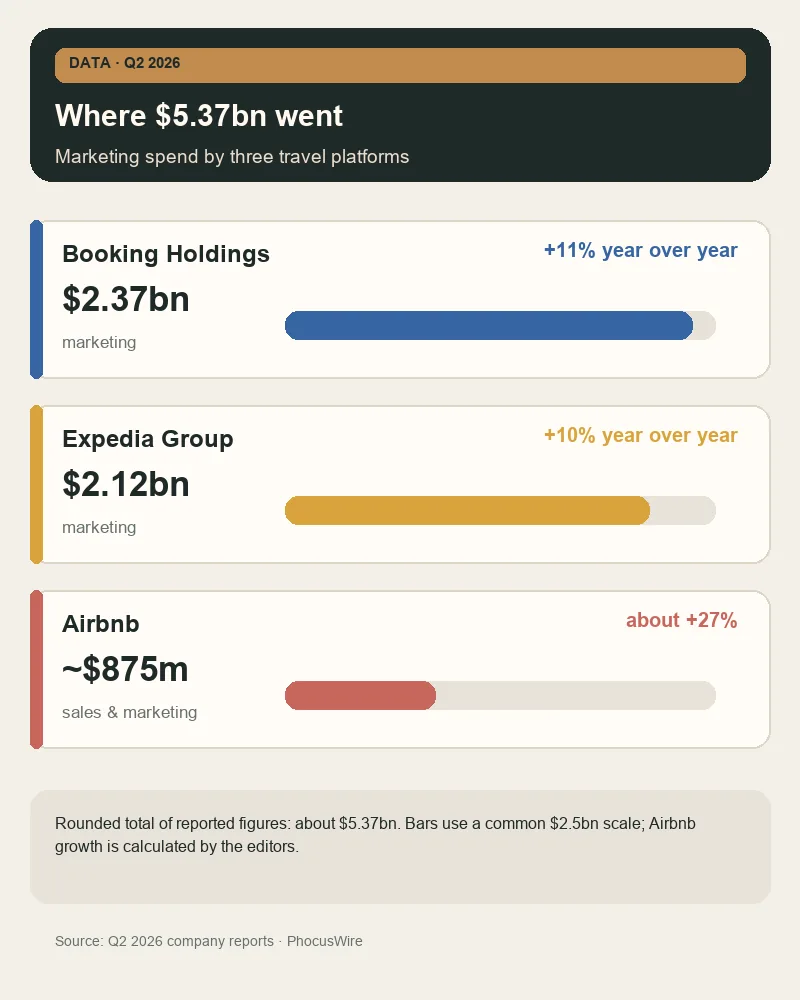
Direct bookings are the platforms’ favourite topic: they love to talk about how many guests come to them directly. The numbers tell a different story: in the second quarter of 2026, Booking Holdings, Expedia Group and Airbnb together spent roughly 5.37 billion dollars on marketing, and each of the three raised its budget. Here is where the money goes and what hoteliers in Georgia should take from it.
Who spent what
Booking Holdings paid the most: 2.37 billion dollars, up 11% from 2.14 billion a year earlier. Expedia Group spent 2.12 billion, a 10% increase. Airbnb’s sales and marketing costs came to about 875 million dollars, compared with 691 million in the second quarter of last year, which by our calculation is a rise of roughly 27%.
For scale: in the same quarter, travellers booked 325 million room nights through Booking, 5% more than a year before, while total bookings grew 9% to 51 billion dollars. The company’s advertising costs grew slightly faster than its sales.
Booking: paying for traffic while it pays off
The chief financial officer of Booking Holdings named three reasons for the increase: a change in the traffic mix, extra paid advertising with attractive returns, and a shift of part of the promotional budget into performance marketing. In his words, the company aims to grow revenue faster than marketing but is ready to spend more when it sees long-term value in the form of returns and repeat purchases.
Chief executive Glenn Fogel said the share of direct traffic has not changed and remains around 65%. At the same time, the company admits that traffic from regular Google search is under pressure and links this to AI overviews in search results. Bookings arriving from AI tools such as ChatGPT still account for well under 1% of room nights. Even so, Booking became one of the first partners of Google’s new AI booking experience and is taking part in tests of OpenAI’s paid advertising.
One more figure worth watching: guests in the upper tiers of the Genius loyalty programme now generate more than half of Booking.com’s room nights over the past twelve months.
Expedia: the money went into B2B
At Expedia Group, most of the marketing growth came from the B2B business, which sells hotels through partners. Its bookings rose 21% to 10.7 billion dollars. Spending on advertising for the consumer brands, by contrast, barely moved: up 1% to 1.10 billion, or 4.7% of bookings in that segment.
Chief executive Ariane Gorin says search engine optimisation delivers stable but weak results, while social media and optimisation for the answers of AI assistants have become some of the fastest-growing channels. Two thirds of Expedia’s consumer business comes direct. The company is experimenting with AI agents and has recently started buying ads in ChatGPT. The CFO added that margins improved thanks to cutting inefficient advertising and moving the money into more productive channels.
Airbnb: advertising as a tool for entering new markets
Airbnb traditionally says little about its marketing strategy. However, co-founder and chief executive Brian Chesky named marketing as one of the pillars of international growth, alongside expanding supply and localisation. The company also mentions local campaigns in growth countries.
In the second quarter, Airbnb’s revenue rose 17% to 3.6 billion dollars, and gross bookings grew 16% to 27.2 billion. Airbnb is also actively bringing hotels on board: guests who book a hotel on the platform are promised a price match guarantee and up to 15% back as credit for their next trip. About 35% of those who book a hotel on Airbnb for the first time later come back to book a home. Hotels still make up a single-digit share of nights, but that share is growing fast.
The billboard effect: how platforms bring hotels direct bookings
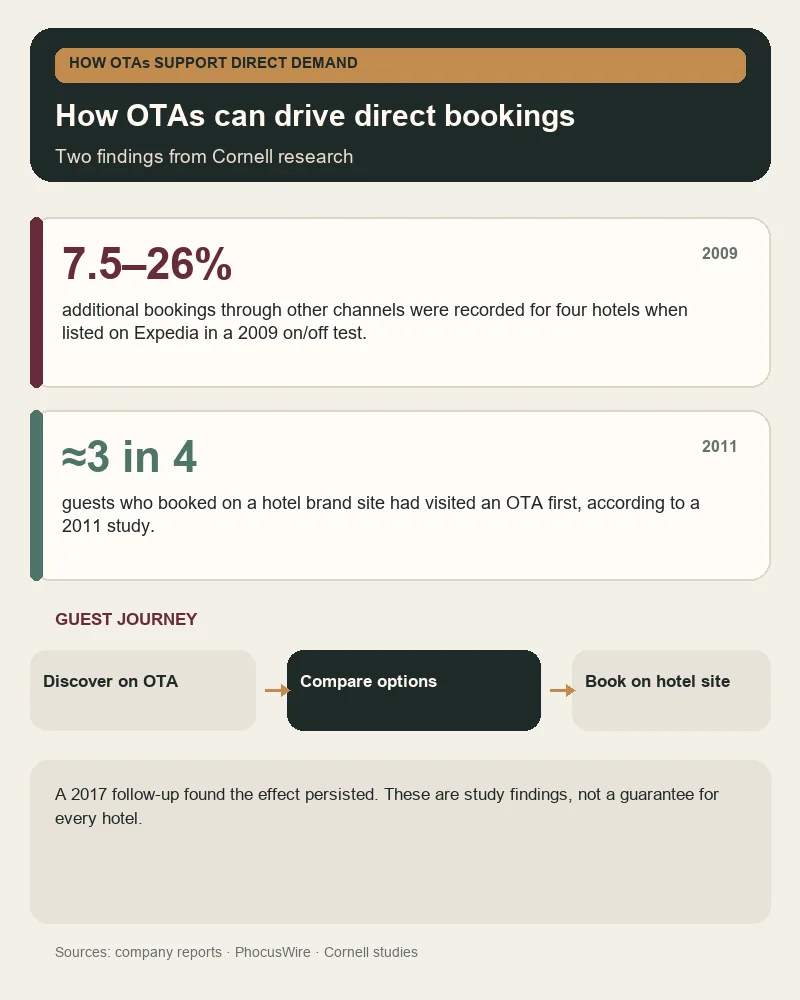
A single hotel has no chance of competing with the platforms in paid advertising. But their budgets have a side effect that Cornell University has studied for years. In a 2009 experiment, Professor Chris Anderson showed and hid a group of hotels on Expedia in alternating weeks. It turned out that being listed added between 7.5% and 26% in bookings through other channels for four hotels, on top of those made on Expedia itself. In a 2011 study, almost three quarters of guests who booked on a hotel brand’s website had visited the platform first. The author suggested treating commissions paid to platforms as a marketing expense. A follow-up study in 2017 confirmed that the effect had not gone away.
Direct bookings: what a hotel in Georgia should do
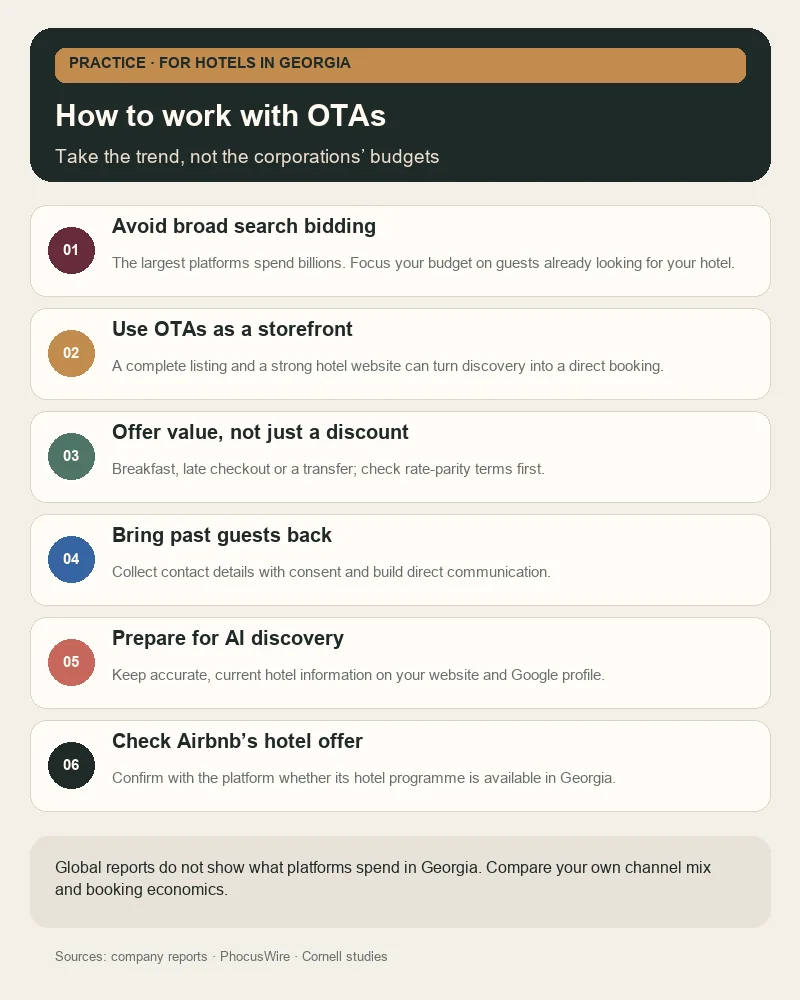
Don’t fight the platforms for generic searches. A budget of billions of dollars per quarter cannot be outbid. A hotel’s ad money is better spent on people who are already looking for that hotel specifically.
Use the platforms as a shop window. Many guests look at a hotel on a booking platform before booking direct. Your website should be easy to find and look at least as good as your listing.
Give direct guests more value, not just a discount. Breakfast, late check-out or a transfer often cost less than the commission. That way direct bookings pay off for both the guest and the hotel. Check the rate parity terms in your platform contract first.
Work with returning guests. Platforms invest in loyalty themselves: at Booking, upper-tier Genius guests already bring in more than half of room nights. A hotel should collect guests’ contacts with their consent and win them back directly.
Get ready for AI booking. It is still under 1% of room nights at Booking, but Google and OpenAI are already launching their own formats. Accurate, up-to-date information about the hotel on its website and Google profile is the minimum for AI assistants to find you. We look at this in detail in where travellers will look for your hotel a year from now.
Take a look at Airbnb. The platform is actively inviting hotels right now. Check with Airbnb support whether this format is available in Georgia.
What to keep in mind: these are reports from global corporations, and they do not show how much the platforms spend in any single country. Take the trend to the Georgian market, not the proportions.