
The HoReCa sector brings together hotels, restaurants, cafés, bars and other businesses that accommodate guests or serve ready-to-consume food and drinks. By mid-2026, Georgia had almost 10,000 active businesses in accommodation and food services.
The term is often applied too broadly, covering everything from travel agencies to restaurant-equipment suppliers. Here is which business belongs directly to HoReCa, which companies operate around it and why the distinction matters to owners and managers.
What does HoReCa mean?
HoReCa combines the opening parts of three English words: Hotel, Restaurant and Café or Catering.
The literal abbreviation does not describe the whole sector. HoReCa includes not only conventional hotels and restaurants, but also hostels, guesthouses, bars, coffee shops, catering businesses and some mobile food outlets.
Official statistics do not usually use HoReCa as a separate category. The closest category is “accommodation and food service activities”. In the NACE classification, this is Section I, covering two broad activities: accommodating guests and serving meals and drinks for immediate consumption. Georgia’s National Statistics Office uses the same classification.
Which businesses are part of the HoReCa sector?
Hotels and other accommodation
The sector includes businesses providing temporary accommodation to travellers:
- hotels;
- resort and boutique hotels;
- serviced aparthotels;
- motels;
- hostels;
- guesthouses;
- holiday homes and other short-stay accommodation;
- camping grounds.
The key feature is temporary accommodation. A flat or house rented as a primary home for months or years belongs to real estate rather than the accommodation sector.
Some properties combine several activities. A country hotel may offer rooms, meals, conference space, a swimming pool and entertainment. Accommodation nevertheless remains the core of its business.
Restaurants, cafés and other food-service businesses
The second major part of HoReCa consists of businesses preparing food or drinks for immediate consumption:
- restaurants;
- cafés and coffee shops;
- bars and pubs;
- bakeries with seating or prepared meals;
- canteens;
- quick-service restaurants;
- takeaway outlets;
- ready-food kiosks;
- food trucks and other mobile outlets;
- banqueting services;
- event and contract catering.
Business size does not determine whether an establishment belongs to HoReCa. A family café with a few tables and a restaurant chain are in the same sector, although their management, costs and business models differ considerably.
Mixed formats are particularly common in Georgia. A bakery may produce bread, sell it at retail and serve guests at tables. Different parts of the operation may therefore fall under different economic-activity classifications.
Who serves HoReCa without belonging to it directly?
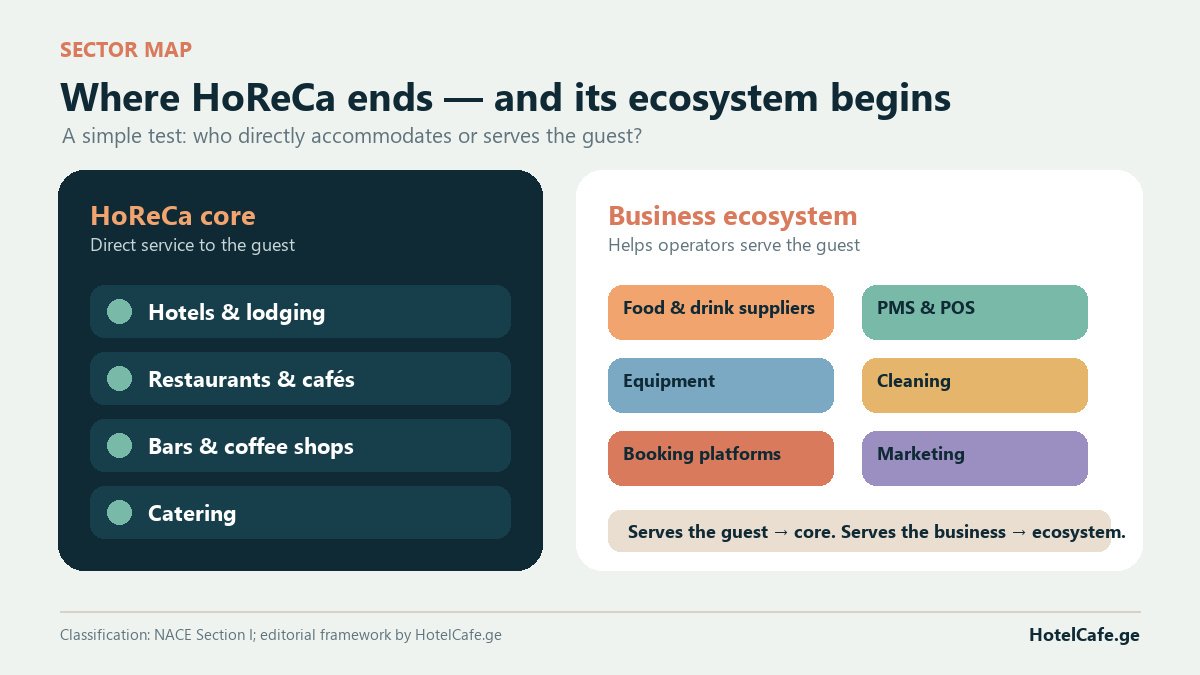
A large B2B ecosystem surrounds hotels and restaurants. It serves HoReCa but is not statistically part of accommodation and food services.
It includes food and beverage suppliers, wine distributors, furniture and textile manufacturers, equipment vendors, PMS and POS developers, cleaning companies, recruiters, consultants, travel agencies, booking and delivery platforms, designers and marketing agencies.
In professional conversation, these businesses are often described as HoReCa market participants. That makes sense when discussing the wider industry ecosystem. In official statistics, however, they cannot be added to hotels and restaurants because they are recorded under other economic activities.
A simple distinction is to ask who serves the guest directly. A hotel accommodates the guest, a restaurant serves a meal, a bar serves drinks and a caterer organises food service. A coffee-machine supplier or POS developer supports that work but does not provide accommodation or food service to the guest.
How many HoReCa businesses operate in Georgia?
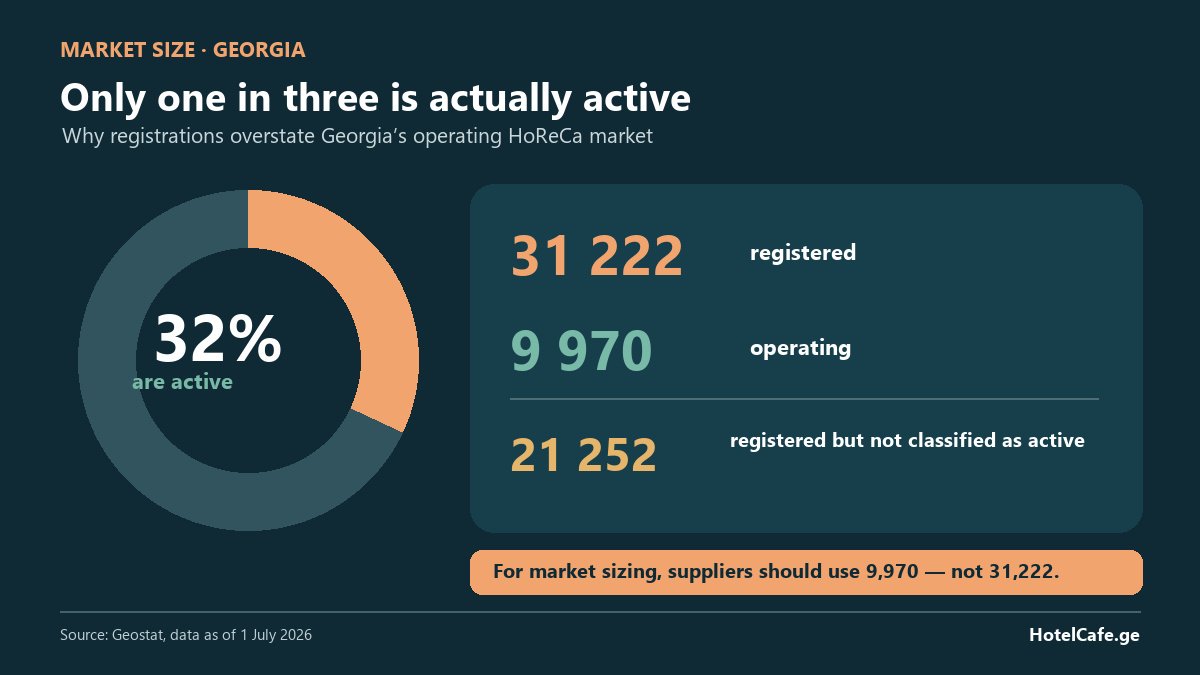
According to the National Statistics Office of Georgia, 31,222 entities were registered in accommodation and food services on 1 July 2026. Of these, 9,970 were active.
That means roughly one in three registered entities was actually active. According to our calculation based on Geostat data, active entities represented about 32% of the registered total.
Registration does not mean a business is currently operating. A company may have suspended operations, closed its venue, changed activity or remained on the register without conducting business. The number of active entities is therefore more useful when estimating the operating market.
This table combines accommodation and food-service businesses. It does not show how many of the 9,970 active entities were specifically restaurants, cafés, bars, hotels or guesthouses.
Georgia’s HoReCa sector continues to grow
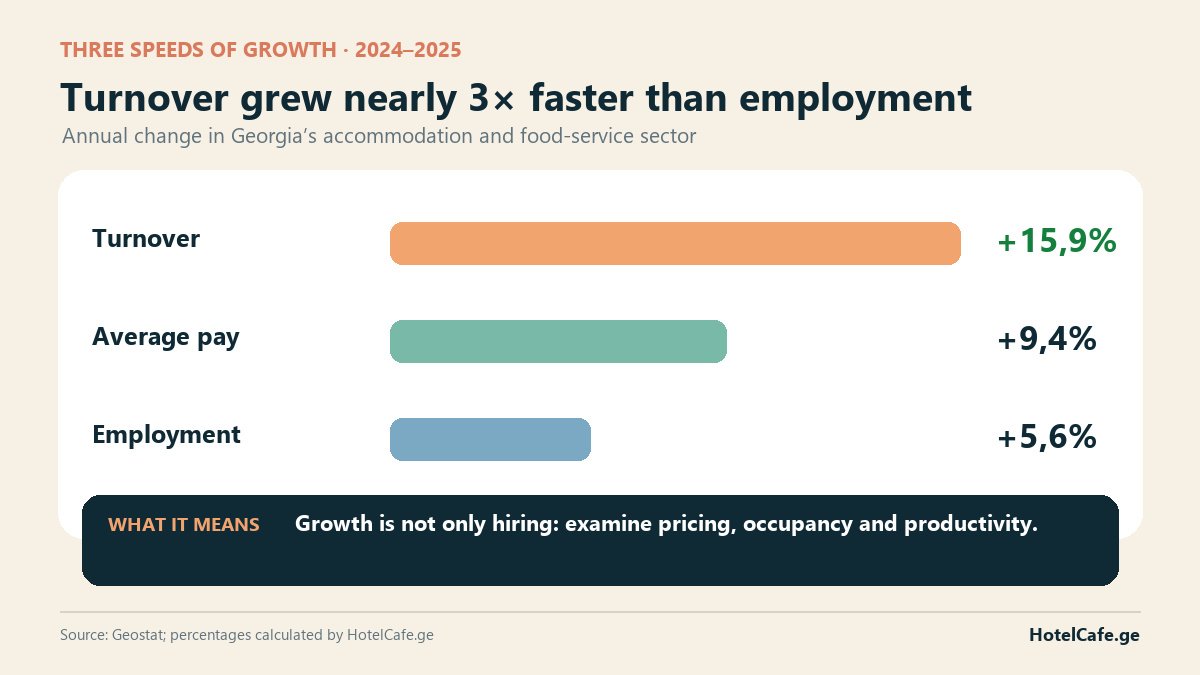
The HoReCa sector in Georgia generated turnover of GEL 3.99 billion in 2025, up from GEL 3.44 billion in 2024. According to our calculation based on Geostat data, this was an increase of about 15.9%.
Over the same period, employment increased from 46,200 to 48,800 people, or about 5.6%. Average monthly pay rose from GEL 1,500.5 to GEL 1,641.1, an increase of around 9.4%.
In the second quarter of 2026, sector turnover was GEL 1.11 billion. Employment was estimated at 47,600 people and average monthly remuneration at GEL 1,924.9.
These figures do not mean that every restaurant or hotel saw profits rise alongside turnover. Inflation, food costs, wages, utility bills, seasonality and the opening of new establishments all affect the result. Turnover measures the sector’s revenue flow, not its net profit.
Why tourism matters beyond hotels
Georgia recorded 5.52 million international tourist visits in 2025, 8.4% more than in the previous year. Revenue from international travel reached USD 4.69 billion. HotelCafe has also examined what the 23% increase in visits from the EU and the UK means for Georgia’s restaurants.
Visitor flows directly affect accommodation, but their impact is much wider. Restaurants in tourist districts, wineries offering tastings, rural complexes, bars, bakeries, caterers and small family businesses also depend on tourists.
The effect is not evenly distributed. A neighbourhood café serving local residents and a seasonal restaurant on the coast may belong to the same industry but face very different demand. National tourism data provide useful context, while owners still need to examine their region, season and guest mix separately.
Why the sector’s boundaries matter to business
HoReCa is more than a label for industry reports. It helps businesses choose relevant comparisons and solutions.
A restaurant should not compare its payroll with all small businesses. A guesthouse gains little from the average occupancy of large chain hotels. An equipment supplier, meanwhile, needs to understand not only the number of venues but also which formats are emerging.
The boundary also matters when reading official data. Statistics for accommodation and food services usually exclude travel agencies, food manufacturers, retailers and equipment suppliers. Ignoring this can lead to a mistaken estimate of the market’s size.
HoReCa contains several different business models
The term groups together businesses working in hospitality, accommodation and ready-to-eat food. Their models are different: a room is sold for a night, a table for one visit, a banquet as an event, takeaway coffee within minutes and catering under a contract at someone else’s venue.
They have different costs, staffing needs, seasonality and ways of attracting guests. HoReCa is a useful industry-level category, but management decisions must be made for the specific format.
For HotelCafe, the HoReCa sector primarily means owners, managers and professionals working in hotels, restaurants, cafés, bars, catering and other hospitality businesses. Technology, equipment and service suppliers are also part of the site’s professional audience, although formally they operate in adjacent industries.
Sources
- National Statistics Office of Georgia — registered and active entities as of 1 July 2026.
- National Statistics Office of Georgia — turnover, employment and average remuneration in accommodation and food services.
- Eurostat — scope of NACE Section I, Accommodation and Food Service Activities.
- Georgian National Tourism Administration — international tourism indicators for 2025.