
European tourists in Georgia are becoming more visible: in the first half of 2026, guests from EU countries and the UK made 23.4% more visits than a year earlier, even though the overall flow of foreign visitors shrank. For restaurants, this is a signal worth noting: there are still relatively few European guests, but each of them spends noticeably more in Georgia than the average visitor.
We follow how tourist flows are changing and what that means for venues in our HoReCa news section.
European Tourists in Georgia in Numbers
According to the Georgian National Tourism Administration, visitors from EU countries and the UK made 249,201 visits to Georgia between January and June 2026 — 23.4% more than in the same period last year. In the second quarter alone there were 152,975 visits, up 19.4%.
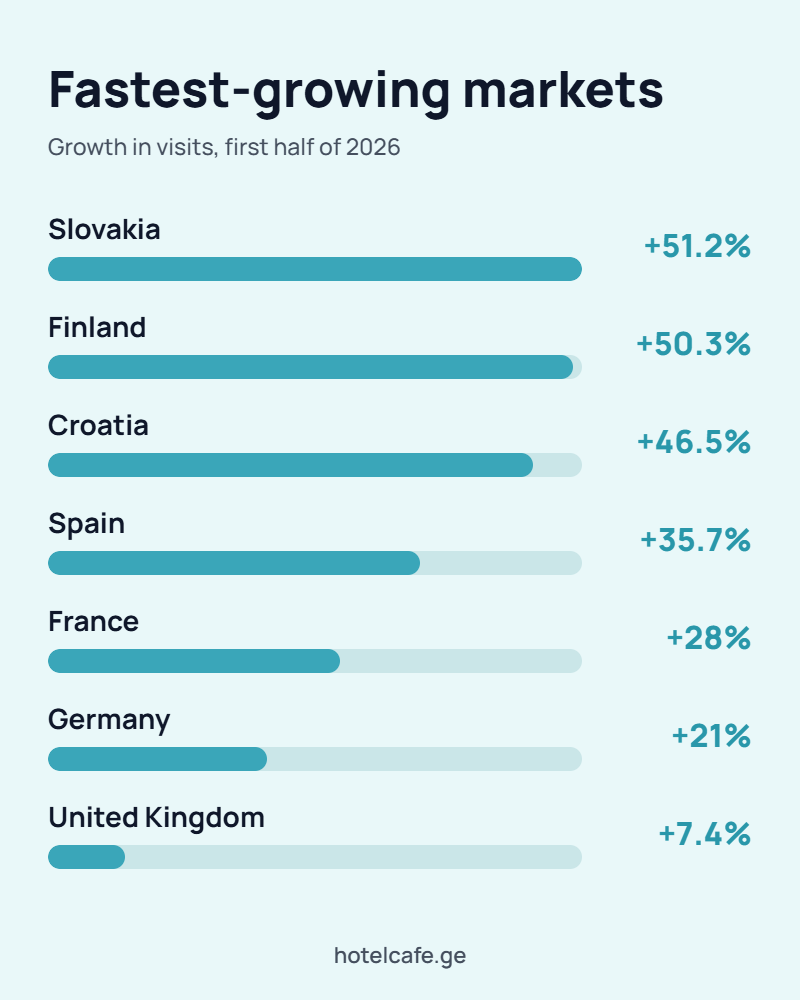
According to the administration, the number of visitors grew from 26 of the 27 EU member states. The fastest growth came from Slovakia (+51.2%), Finland (+50.3%), Croatia (+46.5%), Malta (+42.1%) and Slovenia (+41.1%). Among the larger markets, Spain (+35.7%), the Netherlands (+35.5%), France (+28%) and Germany (+21%) posted notable gains. The UK grew more modestly, by 7.4%.
Against the market as a whole, this stands out. Over the half-year, foreigners made about 3.05 million visits — 3.3% fewer than a year earlier. Tourist visits, meaning trips with at least one overnight stay, totalled 2.27 million — roughly the same as in 2025.
European Tourists in Georgia Spend More
According to the tourism administration, guests from the EU and the UK spent $335.7 million in Georgia over six months — $58.6 million, or 21.2%, more than a year earlier. For comparison, visitors from Russia, according to National Bank data analysed by Newsgeorgia (in Russian), brought in $307 million, despite making 610,825 visits — almost two and a half times as many as the Europeans.
Newsgeorgia also calculated average spending: about $1,347 per visit from the EU and the UK and about $503 per visit from Russia — a gap of almost 2.7 times. Our own recalculation from the same data gives the same figures.

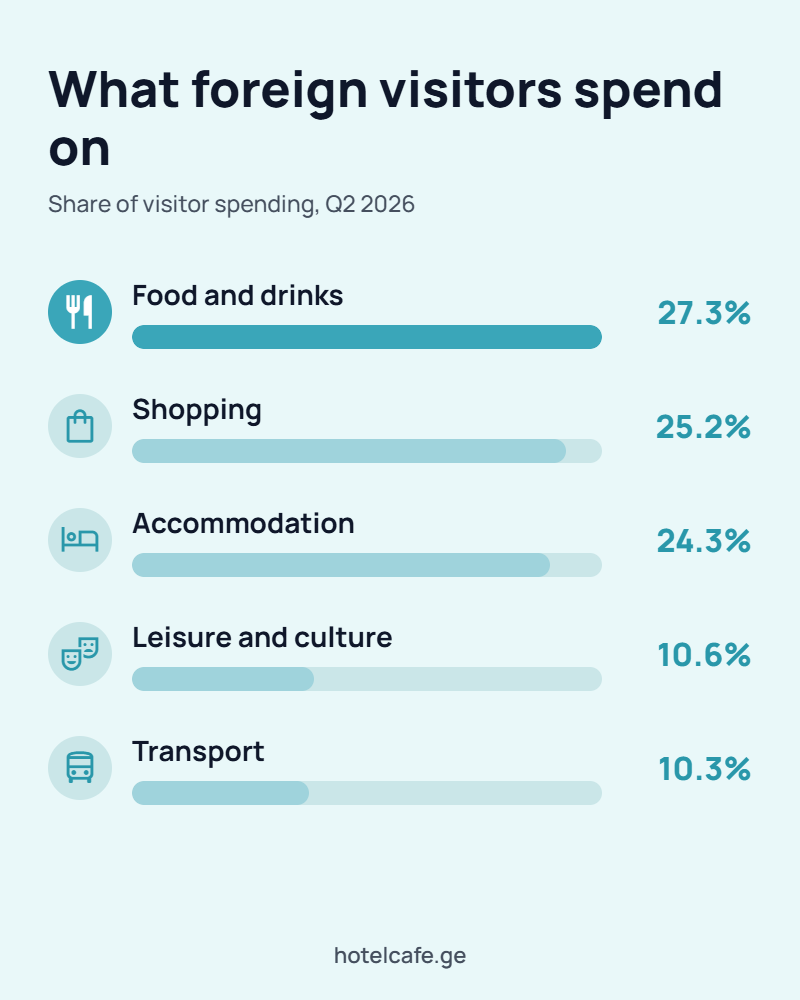
For restaurants, what matters is where this money goes. According to Geostat, food and beverages were the largest item of foreign visitors’ spending in the second quarter of 2026, at 27.3%. Shopping accounted for 25.2% and accommodation for 24.3%. At the same time, average spending per visit fell by 9.2% to GEL 1,922, while trips became slightly longer — 5.48 nights on average. Geostat does not break this spending down by country.
Where Europeans Fly From, and How
The tourism administration links the growth, among other things, to marketing campaigns in Europe and expanding air connections. Georgia’s airports now offer flights to 42 destinations in the EU and the UK, with carriers including British Airways, Austrian Airlines, Edelweiss, Transavia France, Wizz Air and easyJet.

According to Geostat’s second-quarter data, most foreign visitors head to Tbilisi (36.9% of visits) and Adjara (26.2%). That is where restaurants are most likely to notice that European tourists in Georgia are coming more often.
What to Take From This Story
This is not a recipe, just a few ideas — our assessment of what might be useful for venues.
Think about the second visit, not just covers. European tourists in Georgia are still relatively few, but the average foreign visitor stays around five and a half nights. A guest who enjoyed their first dinner may come back during the same trip — or recommend the place to those who fly in next.
Explain the cuisine. Among the fastest-growing markets are Slovakia, Finland and Croatia: for many of these guests, Georgian food is probably new. An English menu with short descriptions of dishes, plus a waiter’s tip on what to order for the table, helps them go beyond a single khachapuri.
Show off the wine. Wine is usually one of the most profitable items on the menu, and for a guest from Europe, Georgian wine can be a discovery. A few options by the glass and a short story about the grape variety let guests try more without committing to a whole bottle.
Be where people search. Many tourists decide where to eat in advance — using maps, reviews and now AI services. We looked at how this search is changing in our piece on where travellers will look for your hotel a year from now: the same logic applies to restaurants.
Sources
- Georgia Today — “EU and UK visits to Georgia hit record high in first half of 2026”: visits and spending by EU and UK visitors, fastest-growing countries, airlines
- Business Insider Georgia — “Georgia welcomes record number of EU and UK visitors”: growth by country, including the UK
- Georgia Today — “Georgia’s tourism revenues fall 2% to $1.9 billion in first half of 2026”: total visits for the half-year
- Newsgeorgia.ge — “Who spends more in Georgia? Tourism revenue in the first half of the year” (in Russian): revenue and visits from Russia, National Bank data
- Geostat — “Inbound Tourism Statistics (II Quarter, 2026)”: structure of visitor spending, average spending, trip length, regions