

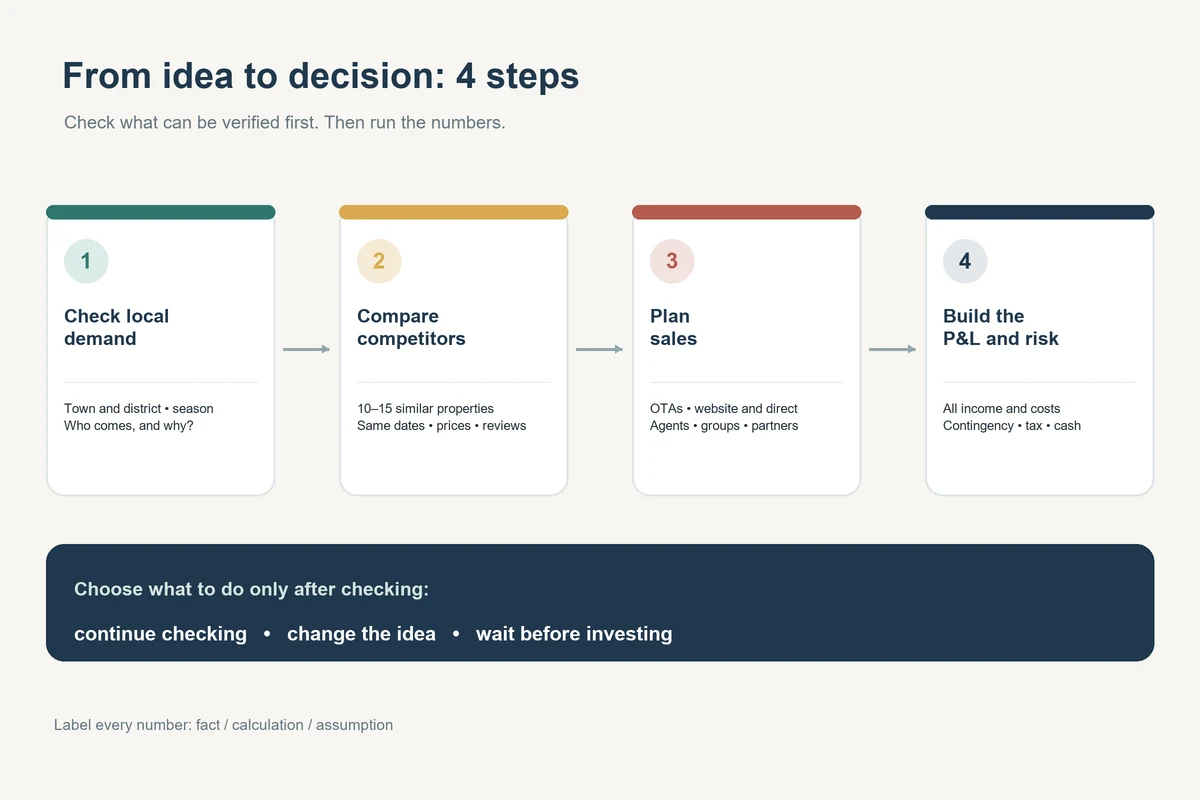
A hotel business plan in Georgia is not a polished presentation. It is a way to test your idea before buying a property, renovating it, or committing to major costs. It cannot predict the future exactly: prices, demand, and timelines will change. It can show weak points early and help you estimate how much cash you will need if bookings grow more slowly than expected.
This practical guide focuses mainly on small, independent hotels. It explains how to check demand in your own town, compare competitors, plan sales, build a monthly P&L, and account for taxes, staffing, seasonality, and expenses. At the end, you can download a one-page idea check, a detailed plan, an example P&L workbook, and a step-by-step guide.
Why you need both a business plan and a P&L
The business plan describes the idea: where the property is, who will stay there, why they would choose it, how bookings will arrive, and how much you need to invest. A P&L (profit and loss statement) turns those assumptions into monthly income and expenses.
It is easy to write “guests will come all year.” A monthly P&L may show that occupancy falls in the quiet season while rent, heating, and salaries continue. A forecast can show attractive revenue and still omit platform commissions, taxes, laundry, repairs, marketing, or the owner’s own work. These mistakes are much cheaper to find in a spreadsheet than after you have invested.
Your plan does not have to match reality perfectly. After opening, compare it with actual results every month and update it. Changing assumptions is normal. Having no plan and relying only on a picture in your head is riskier.
Start with the location and the likely guest
Do not write “our guests are tourists” as your only customer description. Choose two or three likely guest types that fit your location: perhaps families on summer holidays, couples on short trips, winter skiers, weekday business travellers, or groups travelling with a guide. For each group, note why they come, how many nights they stay, which months they travel, what budget they have, and what matters to them.
Then explain why your property suits those people. One location may need parking and an early breakfast. Another may need winter heating, a place to dry equipment, quiet rooms, or the ability to host a group. The difference does not have to be expensive, but it must be clear and deliverable.
Before buying or renovating, check the property documents and permitted use, its technical condition, water, electricity, heating, sewage, access, and safety requirements. Do not approve renovation based on one verbal estimate. Request detailed written quotes and check what they exclude.
How to check demand in your region
National statistics for Georgia cannot tell you whether guests will book a hotel on one particular street. Gather local information for the last two or three years and compare the same months to understand the trend and seasonality.
- Start with Geostat. The hotel statistics portal provides regional hotel indicators such as guests, rooms, revenue, and employment. The tourism statistics section includes surveys of domestic and inbound tourism.
- Ask the local tourism office. Request visitor numbers by year and month, visitors’ countries or regions of origin, typical length of stay, and events or transport changes that affected visitor flows. Ask for comparable periods, not one attractive headline number.
- Talk to people in the local market. Guides, drivers, tour operators, event organisers, and property owners can explain who comes, when they come, and what is missing. Record the date and distinguish an observation from a verified fact.
- Check whether the data fits your property. Regional visitor numbers are not the same as demand for your hotel. Distances, transport, season, accommodation type, and access all matter.
You can ask AI to compare official tables and list missing information, but do not ask it to guess demand. For example: “Compare official data for this region over three years and by month. Link each source, distinguish visitor trips from hotel-room demand, and list what is still missing for a small-hotel forecast.” Check every link and number: AI may combine different measures or invent a figure.
How to research competitors yourself
List 10–15 places a guest could genuinely choose instead of your property: similar hotels, guesthouses, family-run accommodation, and apartments in the same area or serving the same purpose. Record the neighbourhood, format, approximate size, room types, breakfast, parking, and other important amenities.
Compare prices for the same dates in a quiet and a busy season. Availability on a booking platform does not prove occupancy: owners may close dates, and a displayed rate does not mean a room sold at that price. Read recent reviews and note repeated praise and complaints about cleanliness, heating, noise, breakfast, parking, staff, or location. Use these findings to identify what you can improve, not simply to copy another property.
How to forecast monthly hotel revenue
Do not use one annual occupancy rate for every month. For each month, enter the number of rooms actually available for sale, operating days, expected occupancy, and average rate for a sold room. ADR is the average daily rate for a sold room; enter it excluding VAT in the workbook.
Available room-nights = rooms on sale × operating days.
Sold room-nights = available room-nights × occupancy.
Room revenue = sold room-nights × ADR.
Forecast breakfast, transfers, excursions, and other services on separate lines. Estimate how many guests will buy each service, its price, and the cost of food, partners, and staff. Do not add revenue until you know who will generate it and how you will deliver the service.
Arithmetic example only: 12 rooms × 365 days × 35% occupancy is about 1,533 sold room-nights. At an ADR of GEL 180 excluding VAT, room revenue is about GEL 275,940 per year. This is not a market estimate. Seasonality, closures, actual rates, and commissions will change the result.
How to account for seasonality and staff
Seasonality changes both revenue and the number of people you need. Do not multiply one “average team” by 12 months. Plan staff by role and shift for each month. Note which rooms and services operate, how many guests you expect, and how many hours or shifts are needed for reception, housekeeping, breakfast, the kitchen, maintenance, and management.
A ski-area hotel may have its main peak in winter. It may need extra housekeeping and breakfast staff, plus cover at reception and for guest requests. In quiet months, some rooms or the whole property may close. Decide in advance who stays to manage bookings, sales, security, and building maintenance, and who is hired for the season. Do not budget full-year salaries as if the hotel stays busy all year if it will actually sit idle.
In Batumi, Kobuleti, and other locations with a strong summer beach peak, the pattern may be reversed: housekeeping, breakfast, kitchen, and guest-service shifts increase before summer and fall in the low season. Check the pattern for the actual property. Not every seaside hotel is full all summer, and not every mountain property closes outside winter.
Compare three staffing approaches:
- Permanent team. Retains experience and lets you resume quickly, but salaries continue in quiet months. It may suit a property with year-round work such as maintenance, sales, guest reception, or services for local demand.
- Seasonal hiring. Reduces unused shifts in the low season, but requires time to recruit, register, train, and check quality. Before a busy season, several local employers may compete for the same workers.
- A mixed team. Keep a small permanent team for essential work and add seasonal staff for the peak. Staff can share duties only when this does not reduce service quality or safety.
There is no single best model. Compare the full cost, not only wages: employer taxes and mandatory charges, recruitment, registration, training, uniforms, meals, transport or accommodation if needed, overtime, and cover for weekends and leave. For permanent staff, show the cost of hours that may be underused in the low season.
Enter these costs in the months when they occur. Seasonal recruitment and training may need to be paid before the first bookings arrive. In your detailed plan, show the hiring and shift-reduction schedule, who is responsible, and the minimum team needed to open.
A sales plan is different from a financial scenario
A financial scenario asks, “What happens if occupancy is lower?” A sales plan asks: where will bookings come from, and what will you do to generate them? For each month and guest type, list the channel, booking target, rate, commission or discount, responsible person, and specific action.
- Online travel agencies (OTAs). They provide reach, but charge commission and affect your selling terms. Use the terms in your own agreements, not a universal rate.
- Direct sales. Your website, phone, messaging apps, returning guests, and referrals. A website lets you explain your advantages in detail, but it does not guarantee traffic. Budget time and money for promotion and responding to enquiries.
- Tour operators, agencies, and groups. List those serving your target markets. Discuss dates, rates, commission, payment and cancellation terms; confirm agreements in writing.
- Local partners. Depending on location, these may include guides, event organisers, businesses, or transport providers. Record the result of each conversation, not only the contact details.
Do not assume Booking or any other channel will provide a fixed share of the market. Develop several suitable channels and track actual bookings, commissions, and cancellations. A hotel PMS system may help manage reservations and operations after launch.
Build a complete cost list
Check payroll and the value of the owner’s work; utilities; housekeeping, laundry, linen, and guest amenities; food and waste; repairs and maintenance; rent; accounting, communications, software, and insurance; marketing; bank charges; platform, agency, and payment commissions. Record taxes and sales costs separately.
For every amount, record its source and date: contract, invoice, written quote, actual payment, or assumption. Check whether VAT, delivery, installation, and maintenance are included. After checking the list carefully, show contingency on a separate line. Test an additional 20–30% on uncertain costs, and a severe case up to 50% if many costs remain unknown. This is not a mandatory rule or a substitute for quotes. Do not count contingency twice.
Why tax must be included from the start
Georgia’s standard VAT rate is 18%. Mandatory VAT registration is generally linked to taxable transactions exceeding GEL 100,000 in any consecutive 12-month period. Exceptions and status-specific rules may apply, so ask an accountant to check your case. Recoverable input VAT should not automatically be treated as an ordinary expense, but the timing of VAT payments affects the cash in your bank account.
Do not automatically deduct “another 20% when money is withdrawn.” Company profit tax, payments to owners, and dividends depend on the legal form and the specific transaction. Ask a Georgian accountant to calculate your structure before you launch. Check the current Tax Code of Georgia.
What the sample P&L shows
The workbook uses a hypothetical 20-room hotel, with monthly rates and occupancy that vary through the year. Under these assumptions, annual revenue excluding VAT is GEL 811,350 and known operating costs are GEL 636,215. About GEL 175,135 remains before contingency; after an illustrative 25% contingency, about GEL 16,082 remains.
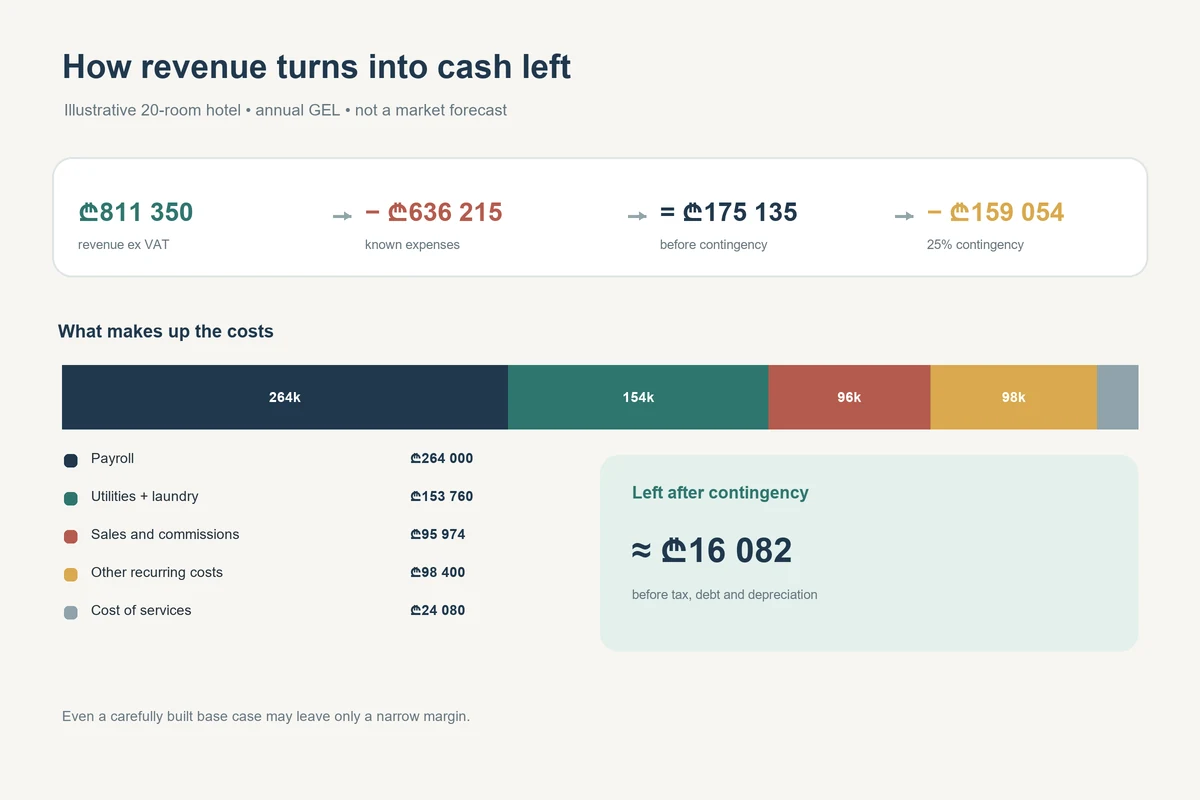
Even substantial revenue can leave little margin. Change the yellow cells to your own figures and test different occupancy, rates, and costs. The P&L does not include property purchase or renovation, loan principal repayments, or bank balances. Use a separate monthly cash-flow plan for those.
Prepare a start-up budget and three scenarios
Build a separate start-up budget for purchase or rent, design, renovation, furniture, equipment, fire-safety requirements, utility connections, website, photography, training, and initial supplies. Get several written quotes for major works and prepare a payment schedule.
In downside, base, and upside cases, change specific assumptions: opening date, monthly occupancy and rate, channel commissions, salaries, and utilities. Note what supports each number. An upside case should rely on confirmed bookings, a partner, or a real sales channel, not hope.
Calculate how many room-nights you must sell to cover recurring costs. Check whether local demand and available cash can carry the property through the quiet season. If a small drop in occupancy makes the project unprofitable, reconsider the rate, size, opening schedule, or cost base before investing.
Download the templates
Start with the one-page idea check, then build the monthly P&L. Once you have local information on the area, competitors, sales, and start-up costs, move it into the detailed plan. The guide explains where to look and how to separate facts from assumptions.
- Download the one-page hotel idea check
- Download the Excel P&L template with an example
- Download the detailed business-plan template
- Download the template instructions
Downloaded a template? Leave a comment below: what helped, what was unclear, and what calculation or file was missing. We will use real questions to improve these resources.
If you can hire a specialist, ask them to review the technical and tax parts before major spending. If you cannot, these templates will help you make an initial assessment and bring specific questions and calculations to a professional.
In brief
A hotel business plan in Georgia starts with a specific location, likely guest, local demand, and assumptions you can check. The P&L tests whether the idea can cover its costs; a separate sales plan explains where bookings will come from. Forecast month by month, include taxes and contingency, and update the model against actual results after opening.